by Catriona Mills

Live-blogging Doctor Who, Season Three: "Daleks in Manhattan"

Posted 14 September 2009 in by Catriona

Well, it’s hit and miss as to whether Twitter wants to tweet this blog post or not. I’ll wait and see what happens, shall I?

Well, what do you know? Twitter has decide to behave itself, after all. Now I’m just bewildered about why it has been intermittently failing to tweet them over the last week or so.

What’s that you say? This is my most boring introduction to a live-blogging ever?

Well, you might have a point.

Still, it’s better than tweeting what I’m watching at the moment, which would not only be spoileriffic but would also probably be bitter. Man, it’s a shame when you don’t really enjoy something that you used to love.

Of course, now I think I’m running late with the actual live-blogging.

No! We’ve just flipped it over, and here we are in Manhattan, with enthusiastic chorus girls rapping on a door and shouting for “Tallulah” to let “Laszlo” go, and to come out onto stage.

I may have spelt either of them wrong, but I haven’t time to check right now.

Of course, as soon as Tallulah disappears, Laszlo hears an odd noise and, like an idiot, he heads out to investigate. (The noise, by the way, can’t decide if it’s more of an oinking, a purring, or a growling.)

It’s certainly not being made by that statue of a pirate.

Instead, it’s coming from that man with a pig’s head. Well, you don’t see one of those every day.

I stopped there to have a quick chat with Nick on a subject of no relevance to this live-blogging, and, in the interim, the Doctor and Martha have landed in New York in November 1930. And, of course, the Doctor notices a mystery in Hooverville, and decides that they’re going to stay a little longer to help solve the mystery.

Hooverville, it seems, is a shanty town in the middle of Central Park, filled with people who have lost their jobs and homes, and can’t find anywhere else to live. We arrive just in time to see “Solomon” break up a fight by dividing a loaf of bread in half.

Good thing they weren’t fighting over a baby.

Solomon, of course, is the man that the Doctor wants to talk to, because he’s the man in charge.

(And drink, if you’re playing Nick’s game of “how many times do people assume he’s a medical doctor,” by the way. Why does no one ever assume he’s a Ph.D.?)

Yes, I should be talking about the plot, but it’s really just a discourse on economics at this point, which is dull to read (I would imagine) and also difficult to recap. But, luckily for my attention span, the scene has flipped to the Empire State Building, where the shift boss is telling the man in charge that he’ll have his men walk out if the “new bosses” don’t stop over-working them.

But, of course, the “new bosses” are Daleks, and Daleks don’t take kindly to threats of industrial stoppages. Ah, and there are also two pig people.

The Dalek tells the pig people to take the shift boss “for the final experiment,” and to replace him with someone who is less likely to care if his men are worked half to death. The Daleks have plans for the Empire State Building.

Back in Hooverville, the Doctor confronts Solomon about the missing men from the shanty town. He tells them that the men are lured away, and that they leave behind them all their possessions, despite owning next to nothing.

But at that point, the boss from the Empire State Building arrives, looking for men to work for a dollar a day. Solomon tells them those are “slave wages,” but the Doctor, of course, volunteers, leaving Martha with no choice but to follow suit. Frank—a young man from Tennessee—and Solomon both volunteer, as well.

And they all head down the sewers. They have torches, but it’s still not my idea of a good time.

Naturally, at that point, they come across what looks like a radioactive jellyfish in the tunnel.

MARTHA: And you just have to pick it up.

The Doctor asks Martha for her opinion, and she says she knows it’s not human. The Doctor’s quite thrilled about that.

Ack! Dalek bumps!

Ahem.

The boss wants his workers to attach the Dalek bumps to the mast of the Empire State Building, but the work has to be done tonight. They object vociferously, because it’s November: their hands will freeze, and the chances of falling are vastly increased.

But the boss doesn’t care, because he’s horrible.

Then a Dalek appears in the lift, and insists—well, he insists that Daleks “have no concept of ‘worry,’” which doesn’t seem true, or why is he pushing for the conductor to be finished tonight, and sounding quite hysterical about it?

Ah, I see: it’s jealousy. The Dalek is now talking about the devastation of Skaro in the Time War, yet Earth continues in various forms through history.

Then we see three more Daleks, who ask the jealous Dalek to bring the boss to them for the “final experiment.” I know this much: if you’re invited to take part in such a thing, it’s never to your advantage.

This goes double if the experiment is being conducted by Daleks. (Also? There are pig people.)

You know, I have a feeling that this is my most incoherent live-blogging in a long time, but there’s really not much to get a grip on in this episode. It’s not what you’d call the most dynamic and exciting of Dalek episodes.

The boss thanks Dalek Sek, the leader of the Cult of Skaro—remember them? From “Doomsday”?—for the chance to rise to power, but Dalek Sek is perhaps the most dismissive Dalek we’ve ever met. Dalek Sek has the pig people bind the boss.

At this point, I’m wishing I’d taken the trouble to learn the boss’s name in advance. I’m not enjoying typing “the boss” over and over.

THE DOCTOR: Oh, but what are you?
ME: A pig person.

Of course, I’ve skipped a step: they’ve found a lachrymose pig person in the sewers, and while the Doctor is comforting him, a posse of pig people appear and chase them.

Well, you know what Hamlet said about pig people: they come not as single spies, but in whole battalions.

Then poor Frank from Tennessee, who left home and hitch-hiked to New York to save his mother the cost of another mouth to feed—poor Frank is dragged from the ladder, and pulled screaming into the pile of pig people.

Poor Frank. He had “red shirt” written all over him.

But the others are safe, and being held at gun point by Tallulah, who demands to know what they did with Laszlo.

Then she tells us what happened to Laszlo, but we know what happened to Laszlo, because we saw it happen.

Still, though, the Doctor does drag the radioactive jellyfish out of his pocket, which prompts Nick to say that Janis Joplin would be very disappointed in how the Doctor is treating that coat.

Solomon is guilt-stricken that he stopped the others from helping Frank, because he—pursued, for the first time in his life, by a posse of pig people—was frightened. I think pig people are fairly frightening.

Martha and Tallulah chat as Tallulah gets ready to go on stage. She’s explaining why she’s able to keep performing when she’s so worried about Laszlo. And Martha finds someone to sympathise with her about the fact that the Doctor is “into musical theatre.” Well, that’s Tallulah’s take on it, but, of course, she’s never heard of Rose.

Back in Hooverville, Solomon is rousing the rabble. Basically, he’s setting up guards, and having them protect Hooverville against the people who appear in the night.

And at the top of the Empire State Building, the men are attaching the Dalek bumps to the mast, despite the fact that they can’t feel their fingers.

In the basement of the Empire State Building, the boss is being restrained by two pig slaves, while Dalek Sek tells him that they “need his flesh.” That’s not something you ever want to hear.

Well, not very often, anyway.

Once the other members of the Cult of Skaro hear this, their xenophobia boils over, and they object vociferously.

NICK: Why is it that senior management always wait until the final meeting before complaining?

But Dalek Sek points out that they’ve all made sacrifices (and the Dalek nose pieces droop plaintively, as they contemplate the missing bits of their skirts, currently being riveted to the building’s mast), and then Sek opens his casing, and sucks the boss inside.

NICK: That’s both gross and implausible.

As we head into an extended musical number (not, I must say, my cup of tea), the Doctor realises that his radioactive jellyfish is genetically engineered.

And Martha sneaks across stage, stepping on devil’s tails and knocking dancers everywhere, because she sees a pig slave standing in the wings—just as the Doctor realises that the jellyfish’s planet of origin is Skaro.

Good thing he took that advanced course in “DNA identification by serial number and, occasionally, taste” at the Academy.

Martha is kidnapped, but she screams loudly enough to alert the Doctor—who is followed by Tallulah, firmly refusing to leave because the Doctor might lead her to Laszlo.

And, hey! There’s Frank. He’s not dead, after all!

Tallulah—talking too loudly—is dragged into a side tunnel by the Doctor, who hears a Dalek coming. Luckily—since the side tunnel is only four feet deep—the Dalek doesn’t look sideways as it passes. I hope it’s not on patrol, but just, I don’t know, nipping out for a carton of milk, or something.

The Doctor rants about Daleks for a little while.

In the basement, the Cult of Skaro want to stop the experiment, because they say that Dalek Sek is “failing.” But Dalek Sek says that the experiment must continue, that they must evolve.

Well, that’s directly counter to everything we’ve ever been told about the Dalek mythos, isn’t it? Still, I suppose a war will do that to the most xenophobic of people.

In the tunnels, Tallulah and the Doctor run across Laszlo, though it takes Tallulah an inordinately long time to realise that it’s Laszlo. To her credit, though, she doesn’t seem too freaked out by the fact that he now looks like a pig. Unlike the other pig slaves, he still seems to have his own mind, though.

Martha and Frank, corralled with the other missing people, are confronted by two Daleks, who discuss their secret plans in front of the prisoners (apparently, the conductor is ready), and then settle down to separating the prisoners into people of low and high intelligence: those of low intelligence are taken to be turned into pig slaves, while those of high intelligence are taken to the “transgenic laboratory” to be used in the final experiment.

Laszlo tries to get the Doctor to leave, but he won’t—so Laszlo sends Tallulah off, while he and the Doctor join the group of highly intelligent prisoners. (The Doctor tells Martha she can kiss him later, which is just mean.)

In the transgenic laboratory, Dalek Sek is entering the final stage of evolution, and the other Daleks “prepare for birth.” Martha wonders what’s going on, and the Doctor tells her to ask them. He’s right, though: as Nick points out, Daleks can be quite chatty.

And they tell her their secret plans: they need to evolve a life outside the shell, because they’re the only four Daleks left in existence.

I don’t quite see the advantages that walking would give them, since the human-Dalek hybrid that’s just stepped out of Sek’s casing looks as though it would be more damageable than your usual Dalek.

Plus, there’s the question of the xenophobia, of course.

Still, we’ll see how they deal with this next week, shall we?

Strange Conversations: Part One Hundred and Ninety-Six

Posted 14 September 2009 in by Catriona

This strange conversation brought to you by a paper bag that I asked Nick (hoarder extraordinaire) to throw in the bin as he went through to put the pirate shirt it contained in the bedroom:

ME (storming into kitchen waving the paper bag): Were you planning on wearing this on your head?
NICK: No.
ME: Is it part of a burgeoning art installation project?
NICK: No.
ME: Is it, perchance, designed purely to be a catalyst for your girlfriend’s sarcasm?
NICK: Yeah.
ME: Really?
NICK: Yeah. I thought you’d like it!

Well, you’ve got to give him credit for resisting the hen-pecking.

Strange Conversations: Part One Hundred and Ninety-Five

Posted 13 September 2009 in by Catriona

Trying to get out of the house to go and buy toner from OfficeWorks (the height of excitement for a Sunday morning), while Nick faffs around instead of getting ready:

NICK: (beatboxing)
ME: Sweetie, no.
NICK: (beatboxing more loudly, and dancing around the study instead of putting his shoes on)
ME: Sweetie, seriously? No.
NICK: You don’t let me have any fun!
ME: I let you have fun all the time.
NICK: Nothing that I would recognise as fun!

Riverfire

Posted 12 September 2009 in by Catriona

Live-blogging Torchwood Season One: "End of Days"

Posted 11 September 2009 in by Catriona

So, here we are for the last episode of season one of Torchwood. I don’t know yet whether they’re heading straight into season two: if they do, I’ll certainly live-blog it, but I think it might be the death of Nick.

Season two was nearly the death of Nick the first time around, actually.

On another note, Twitter keeps refusing to automatically update my blog posts. Why? Why does Twitter hate me so much? (This has no bearing on Torchwood, of course, but I become bored if I have to stop typing for more than a minute or so.)

Speaking to this American woman who asks me if I could go back and do it all again, would I? The answer to that is “Hell, no.” I’d actually go to great lengths to avoid being a teenager again.

But let’s get back to Torchwood, shall we? Ooh, this one contains coarse language and violence! What, no sex?

We flash back to Bilis from last week’s “Captain Jack Harkness,” so we’ll assume he’s also in this episode.

But we begin with Gwen, staring at Rhys as he sleeps. Apparently they’re on good terms again, then. Oh, and he’s naked! That’s fabulous—I really needed to see that at this time of night.

Then Jack rings to ask Gwen if she’s watching the news.

Apparently, there are sightings of UFOs, and also people in “historic dress” across London. Religious extremists are calling it “Judgement Day”—the end of days. And we have episode title!

Cut to Ianto reading from Daniel 12:10 about the end of days, and moving on to read more until Jack cuts him off.

JACK: You people love any story that denies the randomness of existence.

Well, Torchwood is doing its best to counteract the lack of nihilism in modern story-telling, isn’t it, Jack?

Jack points out that this is Owen’s fault, to which Owen responds with a highly offended “What?” But Jack’s right: Owen opened the rift without knowing what he was doing, and these are the aftershocks. Meanwhile, Owen is just mouthing off to Jack and trying to get out of taking Tosh with him to the hospital.

When Tosh and Owen leave, Gwen has a go at Jack about telling Owen off in public, saying all of his staff have feelings, even Owen. “Well, you’d know,” says Jack.

Then Gwen’s friend Andy calls, and points out that they have a Roman soldier in the cells, and what’s he supposed to do about it?

Well, it’s a little more complicated than that, but that’s the main point.

JACK: Under any other circumstances, an exuberant Roman soldier would be my idea of a perfect morning.

We know, Jack.

Gwen tries to reassure Andy that this isn’t the end of days, but he’s not going to believe her because he knows her too well.

In the hospital, Owen and Tosh are investigating a mysterious death: the woman isn’t wearing contemporary clothes, and she’s died of the Black Death. Bubonic plague: fabulous.

Now Owen realises that it’s his fault. For some reason, the bubonic plague is what it takes to trigger it. I find that an odd kink, for some reason.

Then Owen lays into the doctor, just because the doctor is slightly confused by the sudden outbreak of bubonic plague in the middle of Cardiff.

Then Tosh has a vision of a woman with a head wound—Tosh’s mother. She tells Tosh that it’s coming out of the darkness, and also has a secondary purpose of giving Owen an excuse to treat Tosh badly. Again.

Jack explains, quite sensibly, to Gwen why they can’t just open the rift again, but she walks away from him—only to see Bilis in a cell, telling her he’s “so sorry.”

She tells Jack this, back at the Hub, but she can’t tell him anything interesting before Ianto comes in with a weevil: apparently, the weevils are reacting badly to the disturbances. (Jack suspects they might be “time sensitive.” We’re all bloody time sensitive, Jack—just ask my wrinkles.)

Then Ianto gets a vision of his dead Cybergirlfriend (before she was all cyber-y) and she tells him that the only way to stop this is to open the rift.

Owen is a highly insubordinate second in command, isn’t he? If I were Jack, I’d have punched him by now. What does he expect Jack to do? Time is unravelling! How are you supposed to fix it? Great big pair of knitting needles?

But then Owen pushes it too far, telling Jack that since Jack doesn’t even technically exist, there’s no reason for Owen to follow his orders.

Jack fires him.

And Owen responds, as he did before, with “What?”

Nick points out that he’d think better of Owen if he just said, “Fine!” instead.

Jack tells anyone who agrees with Owen that they can leave, too. No one stands forward. And Owen starts getting a little distressed—or is this emotional blackmail?—about the idea that he’s going to be ret-conned within twenty-four hours.

No, not emotional blackmail. He has a genuine breakdown outside. But, you see, Owen, this is what we mean when we say all actions have consequences. You can’t really swear at your boss and tell him he’s an incompetent figment of someone’s imagination (I’m paraphrasing), and then not expect him to sack you, can you?

Jack and Gwen head down to Bilis’s clock shop. He says he can “step across eras,” as someone else would walk into another room. He says it’s a curse: he can see all of history, but he doesn’t belong anywhere.

And Bilis offers the same advice as the apparitions are offering: the rift needs to be opened again.

Jack refuses again, though Gwen seems tempted. And Jack tries to arrest Bilis, but he steps out of time—only to pop up again behind Gwen after Jack has gone, to tell Gwen that he’s not her enemy.

He tells Gwen to hold his hands, and he shows her the future—Rhys’s ugly and violent death. She’s seriously freaked out by this, as you would be, and goes tearing past Jack and straight back home, where Rhys is cleaning the oven.

She grabs Rhys, and tries to pull him out of the house, but when he resists she tasers him.

Hmm, I would think that would be something that she’d have to buy flowers to make up for. Maybe flowers, a pint down the local, and a curry.

Owen, getting smashed in some generic nightclub, sees Diane, who tells him that she’s lost, and he needs to open the rift to bring her back.

This is like a Brannon Braga episode of Star Trek.

Rhys wakes up in the cells, and Gwen tells him that this is where she works. Rhys is, oddly, not really comfortable with this new arrangement.

Gwen tells him that he needs to trust her, but she still doesn’t give him any information, and then she just leaves him in the cell, with wailing weevils next door. Yep, there’s a great deal of trust in this relationship right here.

Gwen is being honest with her co-workers, though: she’s telling them how tactile and real the vision was, so that she could even feel the blood on her hands.

And then there’s a security breach in the hub. Which means the cells are open. And Rhys, since he hasn’t the faintest idea how dangerous things are down there, is happily wandering around. And there’s Bilis, whom Rhys thinks is a co-worker of Gwen’s. But, instead, Bilis stabs Rhys in the guts. Wow. That was unpleasant.

Bilis walks away as the security alarms end, and Gwen and Jack comes haring into the room to find Rhys dead and covered in blood.

Gwen is in screaming hysterics. It’s actually really, really difficult to watch, or even listen to. She’s trying to tell Jack that they can bring him back, but Jack says there’s nothing they can do.

Gwen sits next to the body, and she tells Ianto that she’ll have to tell Rhys’s family. Ianto says they’ll deal with it, but Gwen says, “No.” She says they won’t “deal with” Rhys the way they dealt with the porter the first time she met them.

Gwen is really quite horrible to Tosh here, but I’ll give her a pass. (It’s not as though Tosh said anything horrible. If she’d said, “At least he’s not suffering any more,” I could understand. But “I’m so sorry” is pretty benign. Still, grief.)

And then Owen charges in. And he says he’s going to open the rift. Jack asks Ianto to make sure he stops Owen, but Ianto says no. And they all say no. They say they’re going to help him.

Jack says this is a trap, that it’s exactly what Bilis wants.

OWEN: What are you afraid of, Jack?
ME: Destroying the world?

Jack pulls a gun on them—and, as though that’s not enough, he pulls out every single unpleasant characteristic they’ve ever shown and every unpleasant thing they’ve ever done.

Oddly enough, this doesn’t take as long as you’d think it would.

Then he taunts Gwen with her relationship with Owen, and Gwen punches him in the face.

It’s all about context, Jack.

Owen holds the gun on Jack while the others open the rift, but when Jack taunts Owen, Owen shoots him.

Three times.

I mean, that’s some serious repressed rage there.

And they open the rift.

Jack comes back to life just as the Hub—and, by extension—the world in general, starts going to hell in a handbasket. You know how every time the Doctor tries a fancy maneuver in the TARDIS, sparks come out of everywhere? That’s what’s happening with the Hub.

They flee, as Gwen insists that everything is going to go back to normal now, so they shouldn’t be worrying any more.

But, of course, as they see Bilis in the street, he’s now spouting apocalyptic prophecies, and there’s a—

Oh. Wow. That’s—

Excuse me a moment. I’ll be back as soon as I work out a decent alphabetical representation for repressing hysterical giggles.

Oh, wait. People are lying dead in the streets. That’s suddenly not so funny. Ah, but there we get another shot of Satan—that’s really what it is: Satan—and I start giggling again.

And Gwen asks Jack what they’re going to do. Um, Gwen? Remember the mutiny? And how your co-worker shot Jack? Three times?

Anyway, Jack needs to get out into an open space, since this Satan-creature feeds on life, and Jack is an “all-you-can-eat buffet.”

Wow. This is really silly. I’m sorry, Torchwood. I love you. I do. But this is deeply, deeply silly.

Oh. Jack’s dead. Again. But he looks really bad this time. Gwen’s weeping over him.

But not for long, because now she’s back in her flat with no transition whatsoever, only to find Rhys there. Wait, how? How did the destruction of the Satan-creature reverse what happened before the rift even opened? Let alone reversing the effects of opening the rift?

Oh, never mind. Let’s just put it all down as [technobabble]. Minus the actual babble, of course.

Gwen sits with Jack’s corpse. She thinks he’ll be coming to life again, but there’s no sign of it. They’ve got him all ready to slide into one of the vaults.

Ianto, Owen, and Tosh watch Gwen watch Jack.

Ianto cries as he rearranges the papers on Jack’s desk. He takes down Jack’s coat, and buries his face in it.

Tosh says to Gwen that it’s been days.

No, but wait. Has Gwen stood there for days? And if it’s been days, has Jack been rotting all this time? Or did they preserve him? Because either of those would probably answer the question of whether he’s coming back.

Then Gwen gives him a kiss. And he comes back to life.

NICK: He’ll always come back for a kiss.

Aw, that’s fairy tale, that is.

Ianto runs up and throws himself into Jack’s arms: they embrace and kiss. Then Jack forgives Owen, and Owen throws himself into Jack’s arms, weeping. (They embrace, but don’t kiss.)

Torchwood has really, really lax policies on inter-office romances, doesn’t it?

Jack tells Gwen that the rift closed when the Satan-creature was destroyed, but that it will be more volatile than ever. Gwen tells him about their visions, and asks Jack what he saw. He says nothing: “There was nothing.”

Most nihilistic show on television.

And she asks Jack what would have tempted him, and he says the right kind of Doctor—and we end the show with music that sounds suspiciously familiar, and the sound of the TARDIS materialising.

(Unfortunate, really, that they changed their mind about how that happened before they got to the end of season three of Doctor Who.)

And that’s the end of season one. But Torchwood continues next week, so come back for the live-blogging of the (in my opinion, which is far from humble) definitely superior season two.

Sunbathing

Posted 11 September 2009 in by Catriona

The fruits of today’s lizard-stalking activities:

The Little Princes: Chapter One

Posted 10 September 2009 in by Catriona

This, as promised, is the first chapter of the novel. Be gentle (but critical) with it: it’s only a baby. And, yes, the title is horrible, but it does as a working title.

1 In Which the King and Queen of the Tiny, Deep Kingdom are Introduced

This is the story of two little princes from a tiny kingdom at the far edge of the world, who left one day on an adventure.

The kingdom was at the bottom of a valley so deep that some people said it was actually under the ground.

But the queen, who was a sensible woman, pointed out that she could see the sky provided she stood in the very middle of the kingdom (which was also the middle of her garden) and tipped her head back as far as she could.

Tall mountains surrounded the valley. They were so tall that, rather than having snow on their peaks, they had a thick white belt of snow around their middles. Even the snow found it too cold on the tops of these mountains, which were just bare, grey rock.

The queen admitted that living in such a deep valley meant that her kingdom was cold, and dark, and damp. But, she said, this meant that it was a lovely place to grow mushrooms, and she and the king did like fried mushrooms on their toast on Sunday mornings.

(The king would have eaten fried mushrooms on his toast every day, but somehow he could never manage more than marmalade on a Monday morning, when he had all the business of the kingdom to worry about and another five days before the next weekend. The queen told him that most kings and queens—kings and queens who ruled big kingdoms, not tiny, deep kingdoms—even had to work on the weekends. But the king didn’t believe her.)

The king and queen’s castle was the smallest castle they had ever seen. They’d bought the kingdom when they were very young and newly married. The king’s family had always been poor, but he’d longed to be a king since he’d been a young child. The king’s parents saved up enough money to send him to the right preparatory schools and then to the university that offered the best degree in kingship, and he’d eventually graduated as a newly anointed king.

The universities hadn’t been offering degrees in kingship and queenship for long. They’d started them to exploit what they called “a gap in the market,” and then they’d had to explain to everyone what they’d meant by that: where some of the old-style kings didn’t have children to carry on the royal line, they argued, citizens could have a king who, without being technically royal, was highly trained in kingship.

And, they added, anyone—provided they could afford the rather steep fees—could become a king. (“Even if they’re a woman!” an early advertisement added, until someone convinced them that that was a little tactless.)

And it worked.

But it worked a little too well for the old kings’ liking.

The new kings might not have been of royal blood, but they were very good at their jobs. They were never to be found carousing all night, or off hunting while their citizens were waiting to petition them.

Suddenly, people whose kings didn’t have a degree began to complain. Why, they asked each other, should they have to wait hours to see a king who would only come storming into the hall, surrounded by panting hounds, and then demand ale, when their neighbours had a polite, quietly spoken king with neat handwriting and a diploma on the wall?

The old kings were appalled. They sent their sons and daughters off to the universities to collect degrees, thinking this would calm the citizens down.

But the citizens didn’t want just any king with a degree. The universities has advertised the degree widely, telling everyone that this was the way for them to get the best possible king—and that’s what the citizens wanted.

So when the kings’ sons and daughters came home with their degrees (having done as little work as possible, thinking to inherit the kingdom anyway), they’d found themselves confronting polite, quietly spoken young kings, who’d answered the citizens’ advertisements and already hung their own diplomas in the Great Hall.

And there was nothing that the old kings could do. The universities had simply thought to make a little money, but—with their shiny advertisements and their promises that their kings would listen to any problem—they’d started a revolution that changed kingship across the world.

In some kingdoms, the hereditary kings hung on, the ones who were too young to need to name an heir and too established to bother getting their degrees. But their citizens didn’t mind: they knew that one day they’d be able to advertise for their own accredited king, and they were willing to wait.

The king of the tiny, deep kingdom had found that his troubles started when he left university.

The university was now turning out more kings every year than there were kingdoms in the whole world. The university forbade their graduates from conquering existing kingdoms by force. Any king who started a war with one of their fellow graduates would be stripped of their official university crown (the one with the five golden points) and forbidden to mention the university in any official letters. This was a serious threat: no one wanted to be ruled by a king who didn’t have a degree in kingship.

In the absence of the most traditional method of winning a kingdom, the dozens of kings who graduated each year were forced to find new ways to rule. So new kings were forming little coalitions that allowed six kings to rule one kingdom, each ruling for one day a week and taking turns on Sundays.

(Despite the university’s policies about fighting, vicious arguments took place between new kings about who would be third king and who would have to settle for being fourth or fifth king. But as long as there wasn’t an official declaration of war, the university pretended not to know about these little squabbles. They made most of their money from the kingship programme. Each year, they printed dozens of shiny badges and garish posters with slogans like “Kingship Doesn’t Need Kinship!” and “Want to Fly High? Give Kingship a Try!” They didn’t want to discourage people from enrolling at their university.)

But joining a coalition cost a great deal, and this king was very poor. Six months after he graduated, he was still living in the small attic room he’d rented when he started at the university (where he paid his rent by performing small chores around the house, and helping his landlady carry her groceries home every Friday) and he still only owned one pair of trousers. He could never have afforded to join one of the big, prosperous kingdoms.

But he did have one advantage over his classmates: he had the queen. Unlike the king, the queen hadn’t always known what she wanted to do for a living: even when she was studying queenship at university, she thought she might like to be a gardener. (The queen’s mother had wanted her to study to be a king, but the queen had insisted on enrolling in the queen course, instead. It was more work, but she didn’t have to spend as much time signing papers, so the queen thought it was worth it.) She was delighted when she met the king, because (quite apart from loving him just for himself) she realised that he was so poor she wouldn’t have to choose: she would have to be both queen and gardener.

It was the queen who suggested they look for a kingdom so small that other, more ambitious kings would never want it.

The real-estate agent who sold the kingdom to the king and queen had told them that the castle wasn’t really a castle.

“Really,” said the real-estate agent, “we’d have to call it a cottage. Look, there’s an herb garden. And roses around the door. And it only has three bedrooms. And there’s a pig in the garden.”

But the king said, “No.” He said it firmly. The king liked to say things firmly, because he wasn’t always confident that what he had to say was important.

“No,” said the king. “If I am living here, then it must be a castle. After all, am I not a king?” (The king hadn’t been a king for very long, so he didn’t sound as sure about this as he would have liked.)

And the real-estate agent looked around the tiny kingdom. It had taken him three days to get there, following a trail over the mountains. (He worked in a cosy office in a city by the sea, where he could walk on the beach and feed the seagulls on days when he didn’t have to sell houses.)

He looked up at the mountains.

He stood in the garden—next to the pig, who was optimistically digging for potatoes in the strawberry patch—and he tipped his head back as far as he could, so he could see the sky.

And he looked at the king, who was wearing his graduation crown, the one with the five golden points.

(The queen was wearing the trousers she wore when she was gardening, because she knew they’d have to clean out the castle before they could live in it. But then the queen was much more sensible than the king.)

And the real-estate agent agreed that the king was a king and the cottage was a castle. And when he’d sold them the castle, he went back to his seaside city, where he shared a packet of fish and chips with the seagulls, and thought that at least here he didn’t have to stand in the middle of the garden and tip his head back as far as he could to see the sky.

Post Of Overwhelming Briefness

Posted 9 September 2009 in by Catriona

So, one of the things I’ve been doing this semester—apart from convening a course for (really) the first time ever, and endless live-blogging—is writing a novel.

I don’t know if it’s any good. I’m fairly sure it’s not.

But, since I’ve been blogging, I’ve been less reluctant to show my writing to people. (I never was reluctant to show my academic writing to people, but then that’s the nature of the genre.)

So, I’ve been thinking, diffidently, and the result is this diffident post.

Essentially, I’m asking a question here: would people be interested in seeing some of this novel (a gentle fantasy for children, if that helps, which I’m writing with my nephews in mind)?

I’d love some feedback from people other than Nick, though I’m not sure I’m robust enough to take severe negative criticism.

I have to ask, though.

If you’d like to read such a thing, let me know in the comments, and I’ll post the first chapter as it stands.

And forgive the diffidence: this is the first piece of fiction I’ve written in many years, and I don’t know whether to send it out in the world or not.

Live-blogging Doctor Who, Season Three: "Gridlock"

Posted 7 September 2009 in by Catriona

Dear lord, I’m tired. I just thought I’d put that out there at the beginning of this episode, in case I pass out on the keyboard halfway through.

Or make some embarrassing typing errors.

Either, really.

Still, it’s been a productive day: I just wish I didn’t have night classes tomorrow night, since I would very much like to stay in bed all day.

But that’s enough about me. Why don’t we talk about the Doctor and Martha for a little while?

We begin with Sally Calypso bringing us the traffic news: all car-jackings and accidents, which terrifies the couple in the car, who are dressed as though they’ve just escaped from American Gothic.

Still, in the time it took me to find that link, they were killed by a mysterious creature, so that’s all right then.

Post-credits, we’re in the TARDIS with the Doctor and Martha. He tells her that he’ll stretch the terms of their agreement: one trip into the past and one trip into the future. Martha asks if they can visit his planet, and the Doctor tries to stall. As she pushes him further, he talks about Gallifrey for the first real time in the series: the Citadel enclosed in a glass bubble, with, beyond it, the mountains going on for ever, with deep-red grass and capped with snow.

I cry a little.

But the Doctor snaps out of it, and says no: where’s the fun for him? he asks. He doesn’t want to go home, so instead they’ll head to New Earth, to visit New New York.

Martha is not stupid: she knows that there’s something hinky about taking her to the same planets as he took Rose to.

But before they can thrash this issue out once and for all, and get over the tension, a series of vendors throw up their shutters and start trying to sell the Doctor and Martha suspicious-sounding wares.

Martha asks if they’re selling drugs, but the Doctor says he thinks they’re selling moods: “Same thing,” says Martha.

They watch a young girl buy “forget” to, well, forget that her parents have “gone on the Motorway.” But before they can do more than react to this, Martha is kidnapped by a young couple who, claiming that “they just need three,” drug her to sleep and shove her in a van before flying off as the Doctor chases after them, shouting.

Hey, it’s Annie! Now why didn’t I recognise her from Being Human, when I’ve already seen this episode before?

The Doctor dashes back to the vendors, and asks them to explain what just happened to Martha. They explain about the “car-sharing” policy: you get special benefits when you have three people in the car.

Though they answer all the Doctor’s questions quite happily and without pausing, he then tells them to cash up and shut down, because when he’s found Martha alive and well, he’s coming back to shut them down.

Martha wakes up, and finds the gun that her kidnappers used to take her, but Cheen (the female member of the couple) says that it’s not a real gun.

So Martha listens to Cheen explain that she and Milo are expecting a child, and so they’re heading out the suburbs. Once they get there, they’ll let Martha go. Martha’s keen on that idea, until she hears that the journey will take roughly six years.

The Doctor, meanwhile, is picked up by Thomas Kincade Brannigan, who is a giant cat person (like the nuns from season one) and his wife Valerie—and their kittens. Yes, literal kittens. They’ve been driving for twelve years, and have covered a distance of five miles in that time.

The Doctor tries to leap out, but Brannigan points out that they’ve passed the lay-by: the next one should be in another six months or so.

Martha learns about how one lives in a tiny little van for years on end.

The Doctor, meanwhile, tries to locate Martha. Valerie says that the motorway is completely enclosed: you can’t make outside calls. Brannigan says they can call other cars, as long as they’re on your “friends” list: he calls an elderly couple (he calls them sisters, to which one of them responds acidly that he knows they’re not sisters: they’re married). Fortunately, one of them is a car spotter, so at least she can put the Doctor on the right path.

Back in Cheen and Milo’s van, Martha hears a strange noise: Milo says it’s just the air vents, but Cheen repeats a horror story about monsters that wait for you to go astray and then destroy you.

Martha points out that, given the density of the fumes, it doesn’t look as though the air vents are working, but Milo—looking visibly shaken—insists that Cheen’s stories are just myths.

The Doctor, meanwhile, is destroying his travellers’ faith in their lives, asking them if they ever see police cars? Or ambulances? Or anything?

Unsurprisingly, they’re not thrilled by this interpretation, but, thankfully, at this point, Sally Calypso pops up again to initiate a motorway-wide singalong of “The Old Rugged Cross.”

Martha cries.

Cheen and Milo’s van finally gets access to the fast lane. But the Doctor, not noticeably softened by the hymn, says that if Brannigan and Valerie still refuse to take him down to the fast lane, he’ll find his own way.

He takes his coat off—telling them to take care of it, since Janis Joplin gave it to him and he loves it—then leaps out of the van, saying that he hardly knows Martha, because he was too busy showing off and, besides, he lied to her.

VALERIE: He’s completely insane.
BRANNIGAN: That, and a bit magnificent.

The Doctor works his way down through various vans occupied by a broad range of aliens.

Down in the fast lane, Cheen and Milo are finding that all the Brooklyn tunnels are closed. Milo says they’ll just drive around and around, but a car some fifty yards behind them calls them on the radio, telling them that the tunnels are closed, they’re always closed, and that there’s something down here, something dangerous.

Cue the screaming, both from the car behind and from Milo and Cheen’s car.

The Doctor finally hits the bottom layer, and opens the hatch in the base of the car, looking down into the motorway. He wants to see what’s down there.

Back in Brannigan’s car, a nun jumps through their roof, demanding to see the Doctor.

The Doctor manages to trigger the fans, clearing the smoke, so he can see what’s below. It’s the Macra. Oooh, they’re old-school villains, they are—though, admittedly, they mostly look just like giant crabs.

In the interim, they’ve nearly managed to catch Cheen, Milo, and Martha’s van, but Martha suggests they go to silent running, as submarines do. Of course, Milo points out, they need to turn the engine back on if they want oxygen.

Just as the Doctor is explaining how the Macra once had a mighty empire based on human slaves, the nun leaps down into the van: it’s Novice Hame from the original New Earth episode. She transports the Doctor back up to New New York—and as he insists he needs to see the Senate, she says they’re in the Senate. She triggers the light, and we see the bodies everywhere.

They’re all dead, everyone in the city, and have been for twenty-four years, killed by a new mood called “Bliss,” which mutated to a virus that killed the world in seven minutes.

There was enough time to seal the world off and keep the people on the motorway safe.

Novice Hame said they did everything that they could to keep the system running, and the Doctor asks who “they” are?

Of course, as we know from earlier in the episode, it’s the Face of Boe, who has been giving his life force to keep the city’s systems running. The Doctor asks why they never called for help, and Novice Hame says that the Senate’s last act was to declare New Earth unsafe: the automatic quarantine lasts for one-hundred years. So the Face of Boe and Novice Hame have stayed to keep the only people left on the world, the people on the motorway, alive and safe.

In Milo and Cheen’s van, they talk a little about faith: Martha says they have their faith and their hymns, and she has faith in the Doctor.

They turn the engines back on, so now they’re frantically fleeing the Macra.

NICK: Oh, I don’t see how they can possibly get out of this one!

The Doctor’s trying to wire up the computers, but there’s a problem with the wiring, until the Face of Boe intervenes, to his own peril.

And, suddenly, the roof of the motorway opens up, so sunlight comes streaming down on the cars.

Then the Doctor pops up on the screens of the vans, telling everyone to drive up, so that they can clear the fast lane.

It takes a remarkably short amount of time for all those cars to clear out of the motorway, doesn’t it?

Martha’s faith has been rewarded, but, in a way, the general population’s faith has been rewarded, as well: Sally Calypso might have just been a hologram, but behind that hologram were two people who devoted much of their lives to keeping those people safe.

Well, the rest of their lives, in the Face of Boe’s case. Because the Face of Boe is dying. (Somehow, he’s much creepier out of the glass jar, just a giant face on the floor.)

The Doctor tells Martha he doesn’t know what the Face of Boe is: that legend says that the Face of Bo is billions of years old. And Novice Hame tells them that there’s another legend: that the Face of Boe will speak his last secret at the end of his life.

The Doctor tries to brush this off, but the Face of Boe says no: everything must die, and he is the last of his kind, as the Doctor is the last of his.

This comes as a shock to Martha.

Then the Face of Boe dies, saying, “Know this, Time Lord: you are not alone.”

Walking through the closed-down Pharmacy Town where they came in, Martha asks the Doctor what the Face of Boe was talking about. He tries to blow her off, as he always does.

But Martha sits and refuses to move, saying that the Doctor never talks, never says anything. (And, for the record, I like this pushing past the Doctor’s inhibitions.)

And, as they hear the new inhabitants of New New York singing a hymn in unison, the Doctor tells Martha that all his people are dead, that he is the last of the Time Lords.

Martha asks what happened, and the Doctor sits opposite her, and tells her that his people fought the last of the great Time Wars, for the sake of all mankind—and they lost.

The Doctor talks again about Gallifrey, and the rising of the second sun, the silver leaves on the trees—and his voice fades out against the back drop of the hymn.

David Tennant is crying when he gives that speech about the lost beauties of Gallifrey. (And so was I.)

Next week: Daleks!

First Full Moon of Spring

Posted 6 September 2009 in by Catriona

Well, I Wouldn't Say Literature Is Dead, Exactly . . .

Posted 6 September 2009 in by Catriona

But, yes, I am as disturbed as the next person by the news I found over on Topless Robot: that HarperCollins is bringing out a new edition of Wuthering Heights—with a cover based around the cover art for Stephenie Meyer’s Twilight series, and a tag claiming that this is “Bella and Edward’s favourite book.”

That’s fine: you weep a little if you want. Or faint. Or giggle.

I’ll be here when you get back.

No, this is not a mock-up: here, have a look at the HarperCollins website, where you can pre-order this for only U.S.$8.99.

Now, I do have a problem with this and, oddly, it’s not the same as Topless Robot’s problem: I’m actually deeply fond of Wuthering Heights, as a good little nineteenth-century scholar should be.

It’s such a nasty book, you just have to enjoy it.

(Thought I do admit to bewilderment that people find Heathcliff sexy. Mr Rochester? Oh, my: yes. But Heathcliff? Not working for me, I have to say.)

And, as I’ve admitted here, I enjoyed the Twilight series—at least until Edward started really creeping me out in book three (why, yes: I am a little slow), and until I read book four.

But I have to ask: in what way is this Edward and Bella’s favourite book? If I recall correctly, Bella says it’s one of her favourites, but Edward says he can’t abide it, until he’s stuck with nothing to read while Bella talks in her sleep all night, and then he finds one of Heathcliff’s more psychotic passages about wanting to rend Edgar Linton limb from limb, and suddenly warms to the book.

Not what I would call the most common reason for enjoying Emily Bronte’s only novel.

In the long run, is this actually going to kill literature? I wouldn’t have thought so.

Is it going to make more people read Wuthering Heights? Well, it might make more people buy the novel, and I don’t suppose that the publisher cares whether the purchasers actually read it: it’s not as though Emily’s going to be writing a sequel any time soon.

So this doesn’t mark the death of literature, for me.

But it is deeply, deeply silly.

Still, there’s always amusement value in the tagline, which you can see better in the full-size image.

“Love Never Dies”?

That depends on your definition of “die,” doesn’t it?

And also of “love.”

The Great Spare-Room Book-Moving Debacle

Posted 6 September 2009 in by Catriona

If you were following my Magical Mystery Bookshelf Tour last year, you’ll recall that the spare room was the point where I just stopped apologising for the appalling conditions in which I force my books to live.

In fact, it took me five separate posts before I finished that stage of the tour.

So it’s not really surprising that I decided the spare room needed an overhaul and a new bookshelf.

But despite careful measuring, the bookshelf I bought was slightly too big for the only available space, wasn’t it?

Of course it was.

So the overhaul turned out to be more extensive than planned. Every single item of furniture was moved in this room, and every single book taken off the shelves.

Still, the room looks much better.

In fact, if you were to stand in the direct centre of my spare room—well, you’d be standing on a patchwork quilt that my sister made me by hand, and I’d probably ask you not to do that.

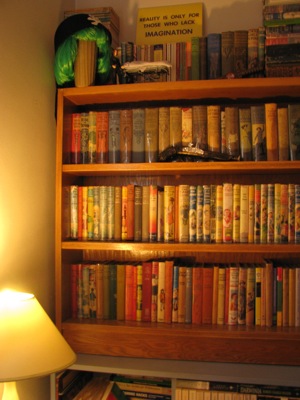
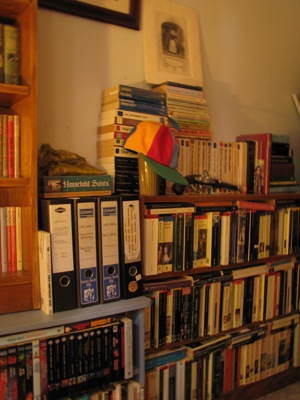
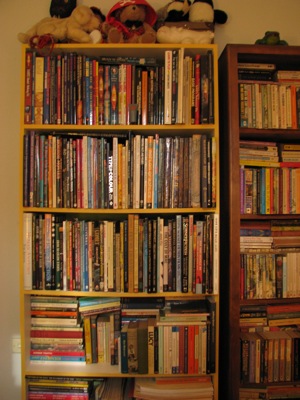
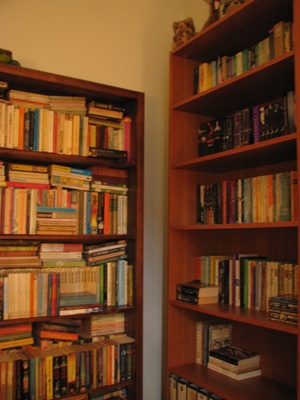
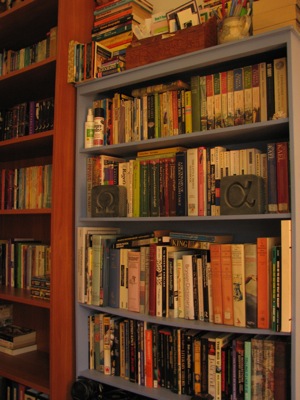
Still, setting that aside for the time being, if you were to stand in the direct centre of my spare room and look from left to right, you’d see it looks like this now:

And, yes: that is an almost empty shelf there. Clearly, there are more than enough books still on the other shelves to fill that one up. But it gives me such a luxurious feeling of space, to have one shelf in the house that isn’t stuffed to capacity.

So empty it stays.

Until the next Lifeline Bookfest, anyway.

Just Because They're Sharing The Same Washing Line

Posted 5 September 2009 in by Catriona

Doesn’t mean they have to like one another.

Strange Conversations: Part One Hundred and Ninety-Four

Posted 5 September 2009 in by Catriona

Oh, just one of those mornings:

NICK: That was your fault, and you know it!
ME: How? How?
NICK: Don’t ask me. I don’t know it. You know it.

Strange Conversations: Part One Hundred and Ninety-Three

Posted 5 September 2009 in by Catriona

ME: What are you doing?
NICK: I’m trying to get Windows to work properly.
ME: Oh, right. Because that’s much more important than doing the washing up.
(Pause)
NICK: And you say I’m passive-aggressive!
ME: You are passive-aggressive! Doesn’t mean I can’t be passive-aggressive, too. It’s not as though there’s a finite quantity of it.
NICK: That’s true.

Categories

Blogroll

Recent comments

Monthly Archive

2012
January
February
March
April
May
June
July
August
September
October
2011
January
February
March
April
May
June
July
August
August
October
November
December
2010
January
February
March
April
May
June
July
August
September
October
October
December
2009
January
February
February
April
May
June
July
August
September
October
November
December
2008
February
March
April
May
June
July
August
September
October
November
December