by Catriona Mills

Articles in “Books”

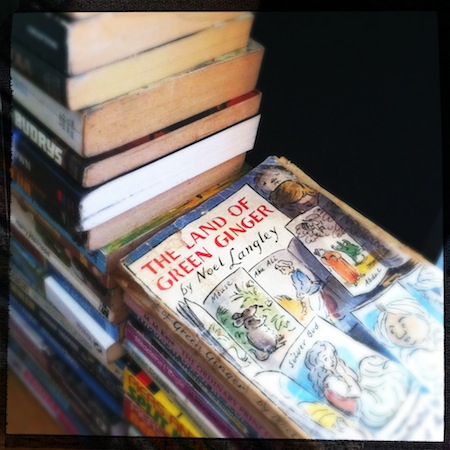
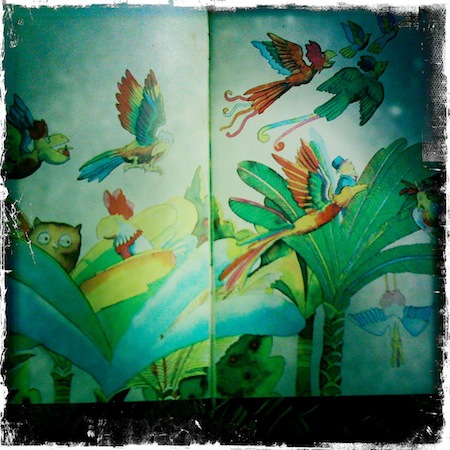
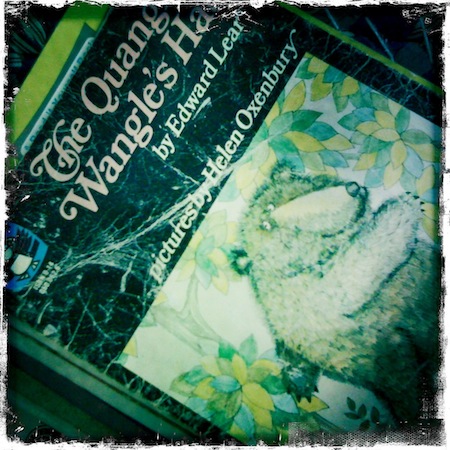
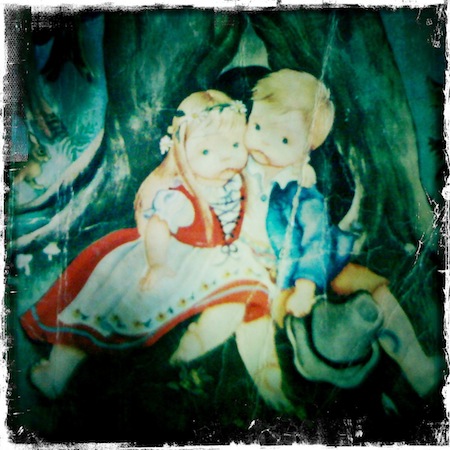
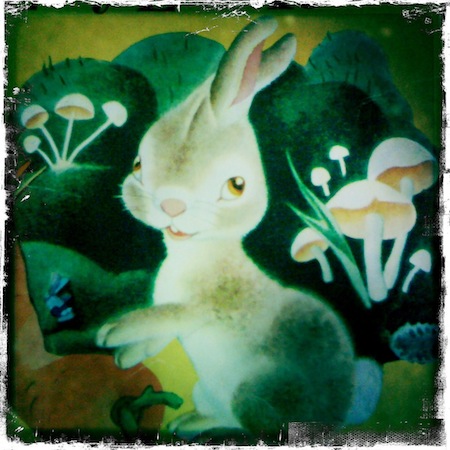
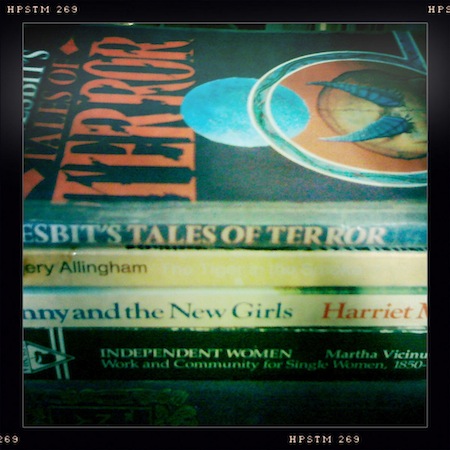
The Existential Horror Of Boarding-School Life

Posted 2 March 2010 in

Most of the horrors of boarding-school life are fairly well understood: horrible food, snoring roommates, abject bullying, indoctrination into a rigid and aggressively snobbish middle-class ideology . . .

Actually, that last one might just apply to Enid Blyton.

But have you considered these other, less well-known risks to boarding-school life?

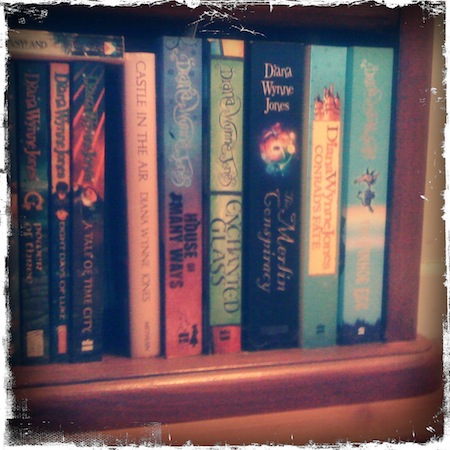
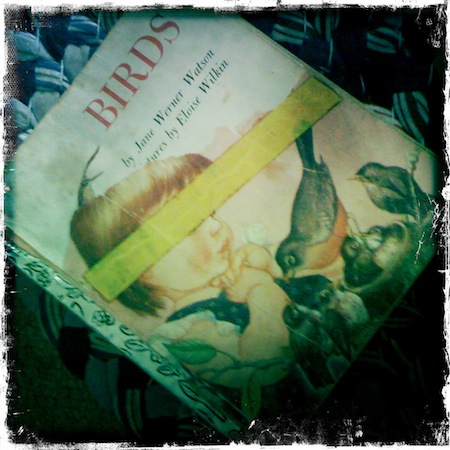
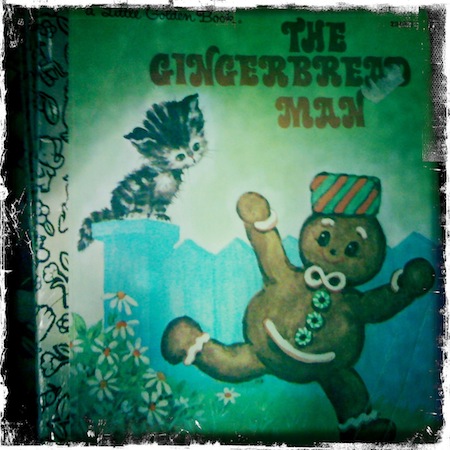
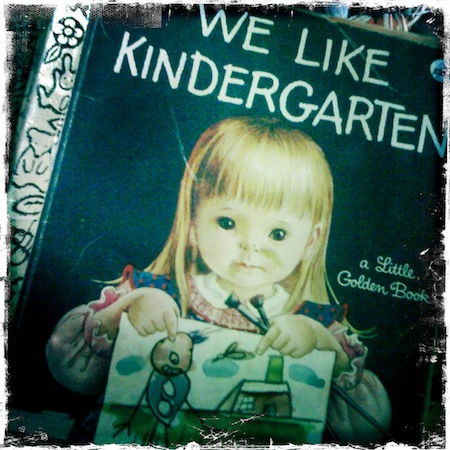
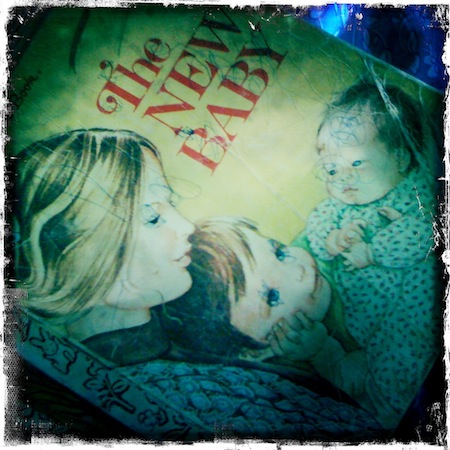
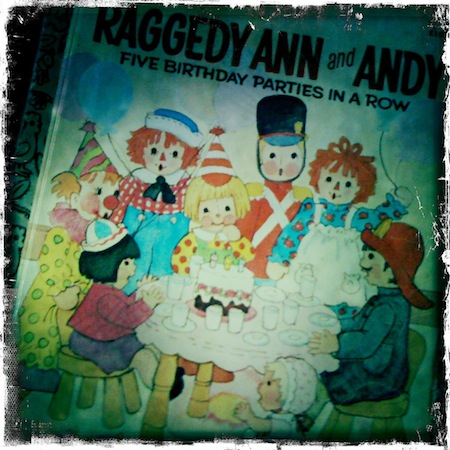
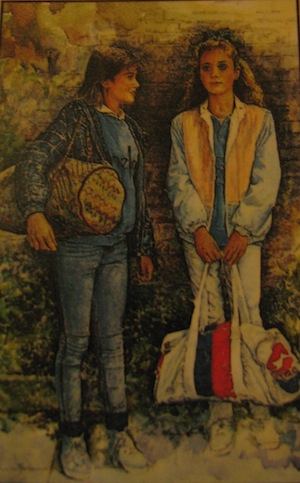
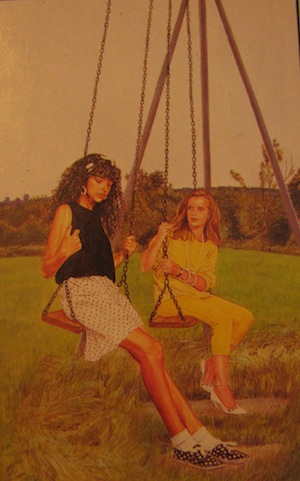
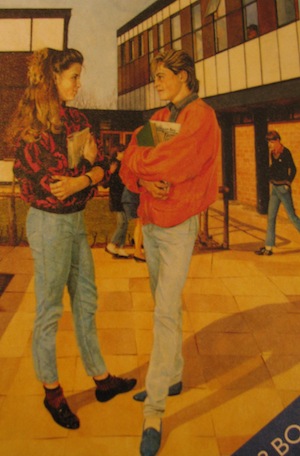
Impromptu fiddle performances by sickeningly cherubic classmates:

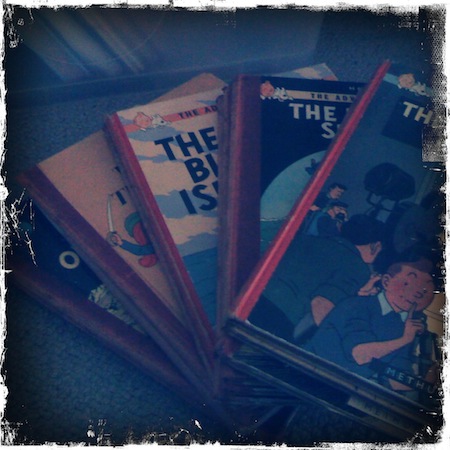
Risk of shipwreck:

Compulsory victory parades:

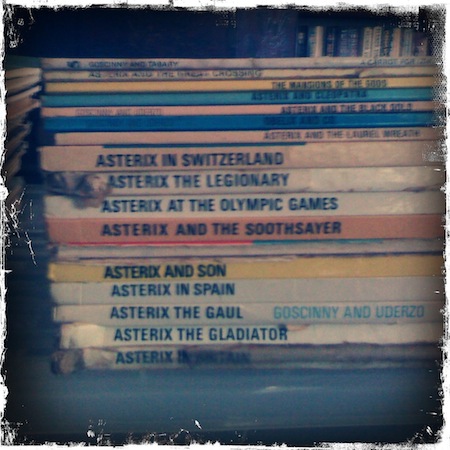
Assessable antiquing:

And the greatest threat of all:

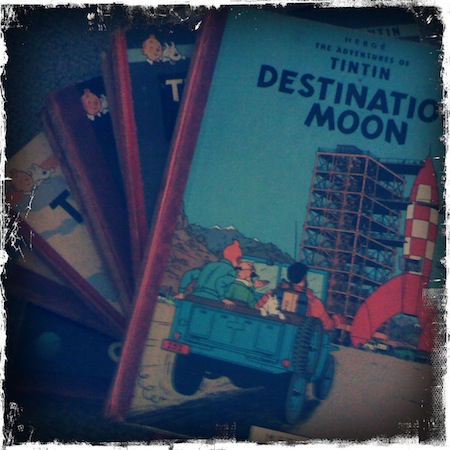
That’s right: uncontextualised pointing.

Re-reading Part Two: Charlaine Harris

Posted 24 February 2010 in

(Part One of this extremely intermittent series, in which I am annoyed by David Eddings, is here.)

Whenever you Google “literary fiction versus genre fiction,” as I’m sure we’ve all done at some point or another, you find people defining literary fiction as “character-driven” and genre fiction as “plot driven.”

Like most statements predicated on the construction of monolithic categories, this is more than a little problematic. And if you want to see genre fiction that is as character driven as it is plot driven, try Charlaine Harris’s Lily Bard Mysteries.

Oh, sure: they’re murder mysteries, and I’d be pretty disappointed if we didn’t, at the end of the day, find out whodunit. But these five books are as much about the slow warming of Lily as they are about the murders.

Lily, you see, has become nothing but the sum of what happened to her. Abducted, raped, mutilated, and subjected to prolonged media exposure, she’s trapped by her own victimisation. When people say to someone, “Well, it could have been worse,” their eyes slide over Lily and away again: she’s the worse that could have happened.

So she leaves. She leaves her small home town, her job, her family, and she moves from small town to small town in the southern states of the U.S., always leaving when her past becomes known—until she reaches Shakespeare, Arkansas, a town founded by a home-sick, literature-loving Englishman, and which she picked off the map because her own name is Bard.

Here she chooses to stay when her past is revealed, when her scars are (quite literally) revealed. Here she works on her body-building and her karate, so that, as she says to a small girl who praises her strength, no one bothers her now. From here she can even go back to her home town to act as maid of honour for her sister and cope with the anxiety and distress her presence always causes her loving family.

I always want to know whodunit.

But with the Lily Bard Mysteries, I’m far more concerned with watching Lily move away from her self-defensive, self-protective pose, a pose marked by an extreme lack of affect, to one that’s warmer, more engaged, more open—all the while remaining a woman plagued by bad dreams, a woman who walks and walks on nights when she can’t sleep, a woman who can’t brook any form of restraint for reasons so horrific that we don’t want to think about them.

Or how about the Harper Connelly Mysteries? Unlike the Lily Bard Mysteries, these have the supernatural element for which Harris is probably best known in the wake of True Blood.

But something about Harper breaks my heart. Struck by lightning at age fifteen, Harper can now find dead bodies, tracking them by a buzzing sense that grows more intense the fresher the body is. The only one she can’t find is her sister Cameron, who disappeared aged eighteen somewhere between her school and the family’s trailer in Texarkana.

Like Lily, Harper is damaged, but for different reasons. Harper’s is a riches-to-rags story: lawyer parents who become enamoured of the lifestyles and vices of the people they represented, and who shed each other on the way from white collar to blue collar and below. Ultimately, Harper’s mother marries a man with two children of his own and they have two more children: until Cameron disappears, the older children work to care for the babies and prevent Child Services from finding out what’s happening in the Texarkana trailer.

Part of the damage to Harper comes from that: any teenager would carry scars if their mother had tried to sell their virginity for drugs.

Part of it comes from the lightning strike. Harper was kept alive by her stepbrother Tolliver, who performed CPR until the ambulance arrives. The lightning strike leaves her with a series of weaknesses and symptoms rejected by the general medical community, who maintain that there are no long-term effects to a lightning strike, despite the weakness of Harper’s right leg, the shaking in her right hand, the severe headaches. It also leaves her with an explicable fear of natural disasters: when Tolliver asks what the chances are of lightning striking twice, she merely asks what the chances were of it striking once. And it leaves her with a more generalised fear of the unknown and unexpected, a tendency to panic when faced with a disruption to her usual pattern.

And part of it comes from her work. When she finds a body, Harper can also see how they died—just a brief flash of their last moments from their perspective. The work is draining. If she weren’t accompanied by her manager and stepbrother Tolliver, she wouldn’t be able to accomplish it.

So they travel constantly, from job to job. Most of their work is in small towns in the southern states, towns that are usually fundamentalist communities. Most people with whom they deal believe they are con men. Some think they are genuinely evil. Harper is threatened, sometimes struck, shot at, and on one occasion actually stoned.

Is it any wonder she breaks my heart a little?

Even Sookie Stackhouse, from the comparatively light-hearted Southern Vampire series, is a damaged heroine, abused by her great-uncle as a child and so limited by her uncontrollable telepathy that the townsfolk assume she is insane or developmentally delayed. Sookie doesn’t fall into sexual relationships with vampires because it’s fashionable (though it is) or because they’re sexy (though they are): she does it because she can’t read their minds. They’re about the only creatures with whom she can enjoy a normal relationship.

And those vampires!

Vampires in Harris’s world are as powerful and potent as they are in most vampire fiction. (Much more so, in fact, than in the television adaptation where Eddie found, heartbreakingly, that he wasn’t any more successful at picking up men as a vampire than he had been as a man). Indeed, their blood is a literal drug, with a staggering street value, leaving them as vulnerable to “drainers” as they are to the fundamentalist, vampire-hating Fellowship of the Sun.

But vampires in Harris’s world are also a bit naff. They run clubs called things like Fangtasia (just as the werewolves congregate in a pub called Hair of the Dog), where the sell such merchandise as T-shirts emblazoned with blood-dripping fangs or “Hunks of Fangtasia” calendars. They hang out in New Orleans, amusing the tourists. In short, they both exploit and revel in every stereotype about vampirism that humans can imagine—all the while being entirely dangerous and not at all human.

Am I arguing that Harris is flawless? Of course not. Her continuity errors, for example, are myriad: minor characters flip from one side of the family to the other, or shift names, or forget key plot points between one book and another. (Or, in one case, forget what kind of animal they shift into.)

But I am arguing that she’s not only enormous fun, she’s a writer who specialises in making damaged characters well-rounded and engaging; who offers a detailed revisioning of small-town life in the southern U.S.; and who recognises that vampires are both appealing and naff.

What’s not to like?

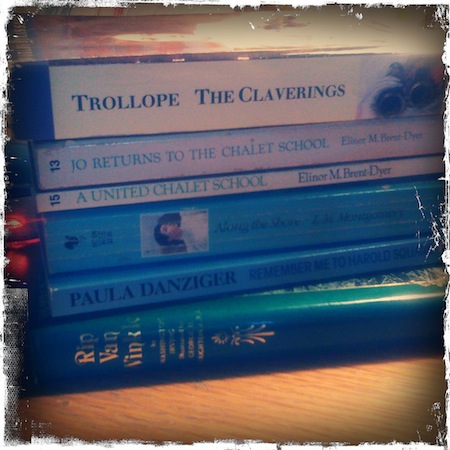
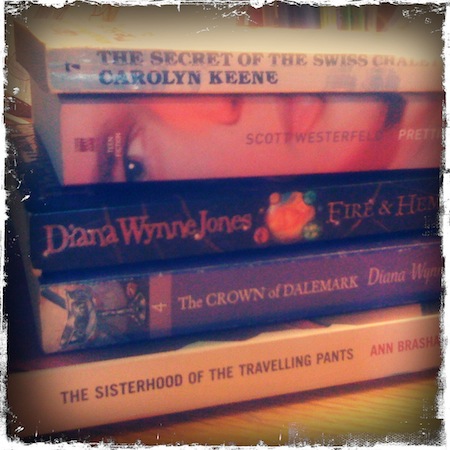
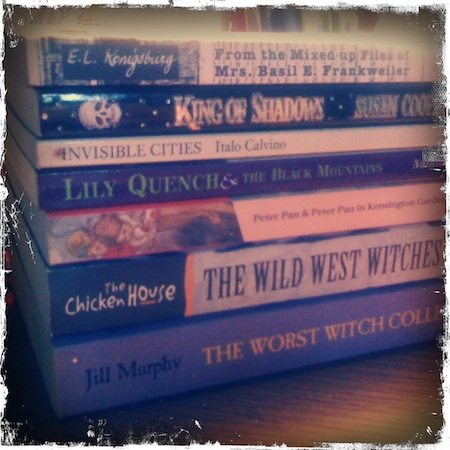
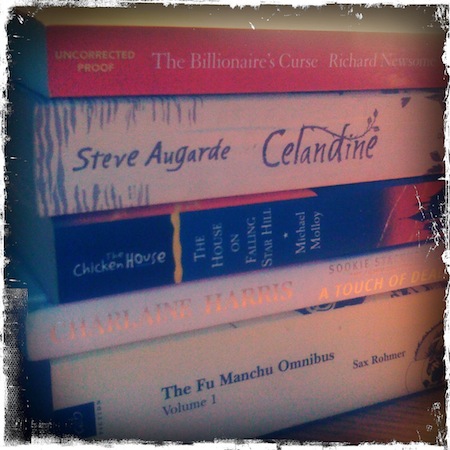
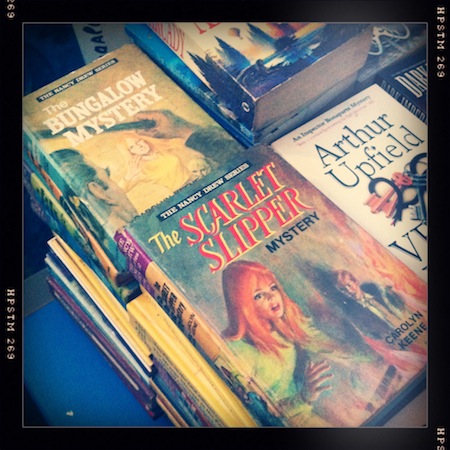
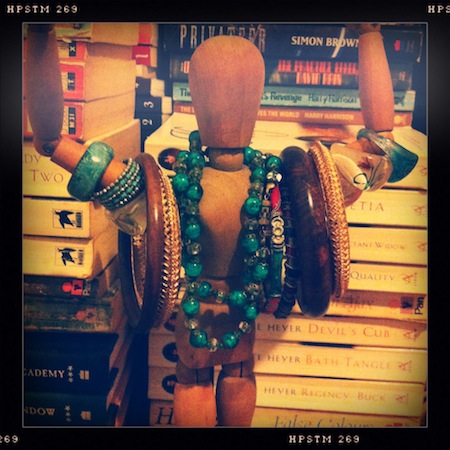
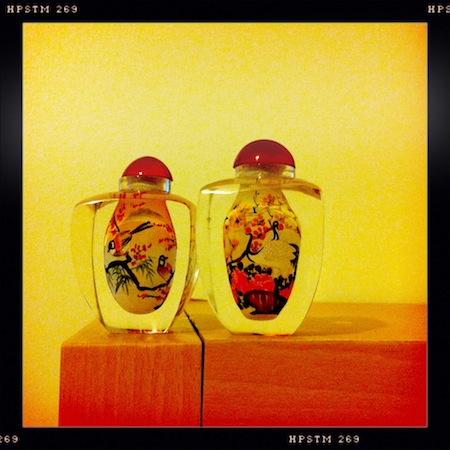
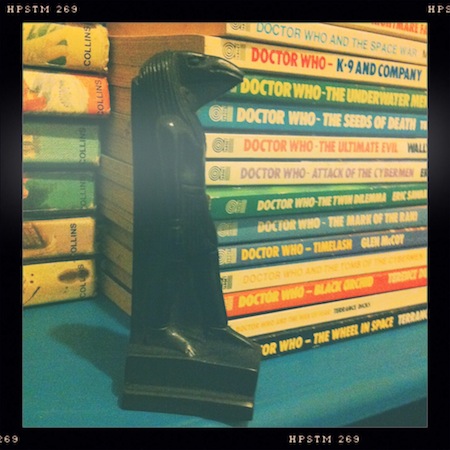
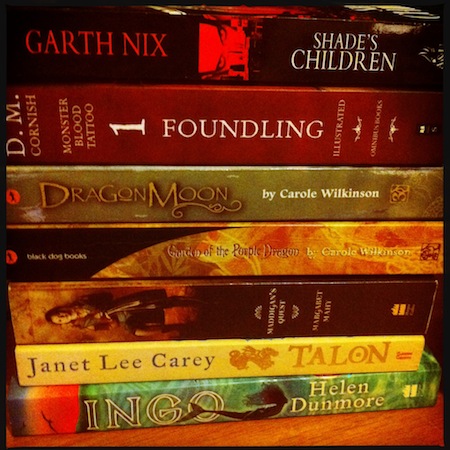
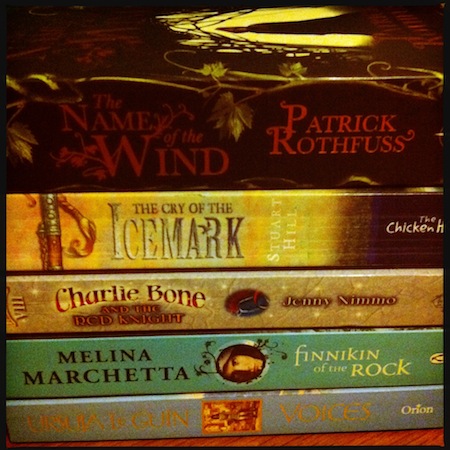
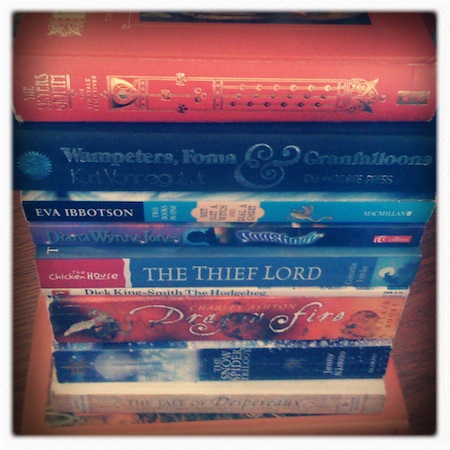
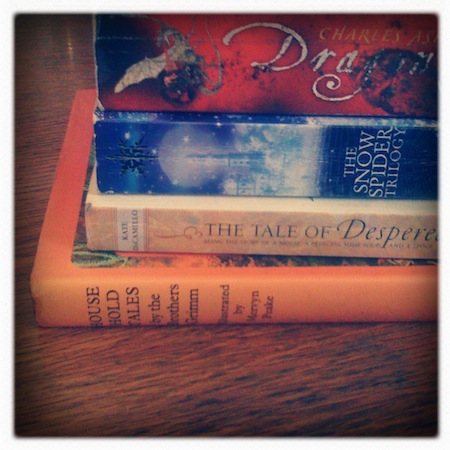
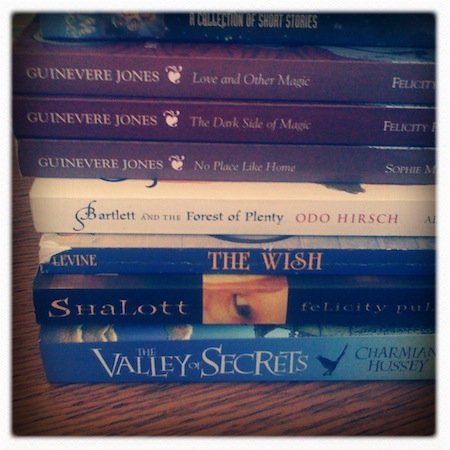
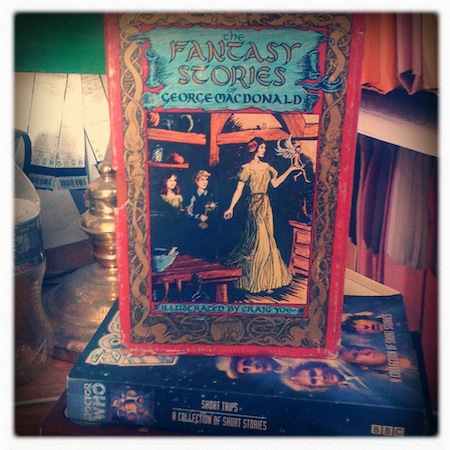
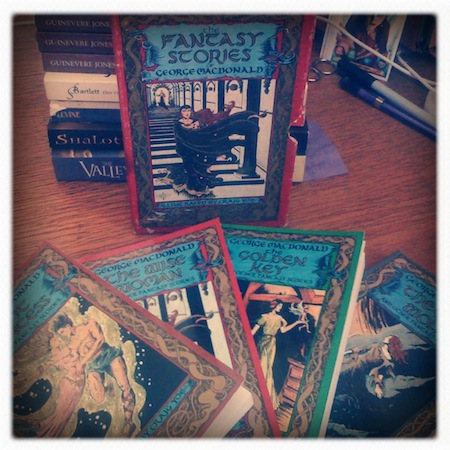
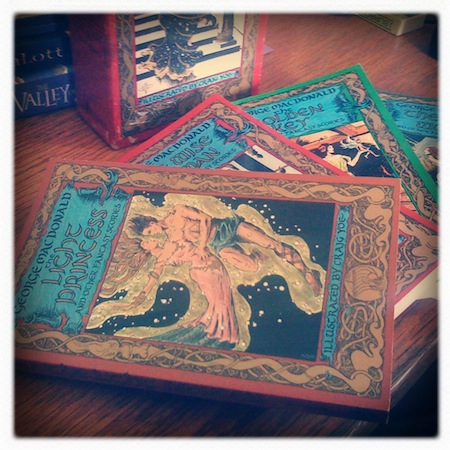
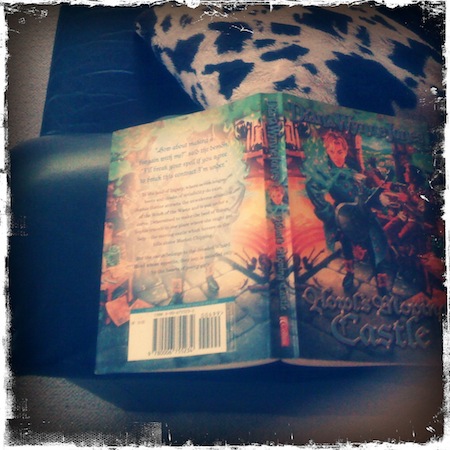
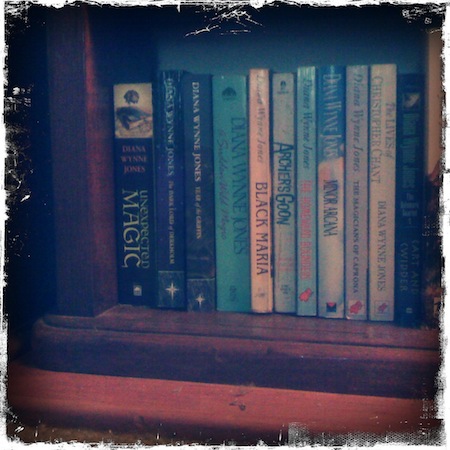
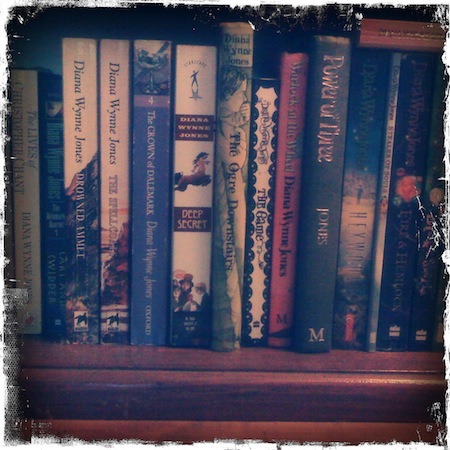
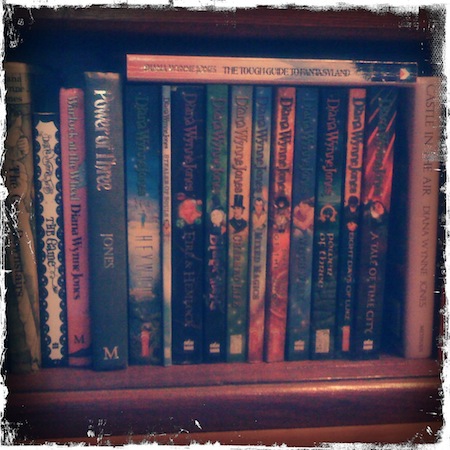
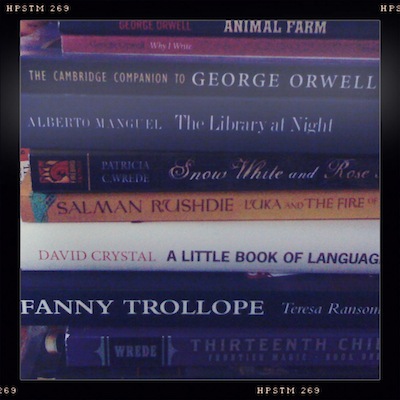
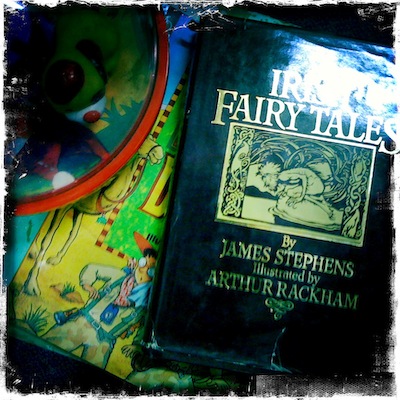
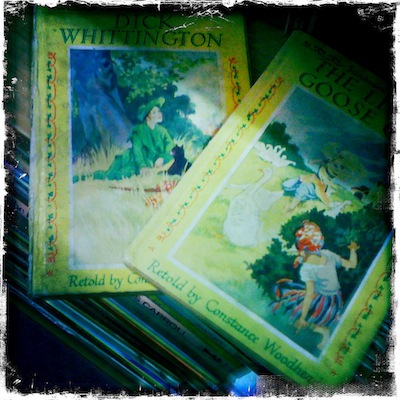
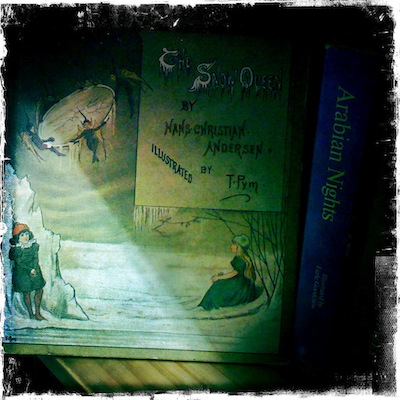
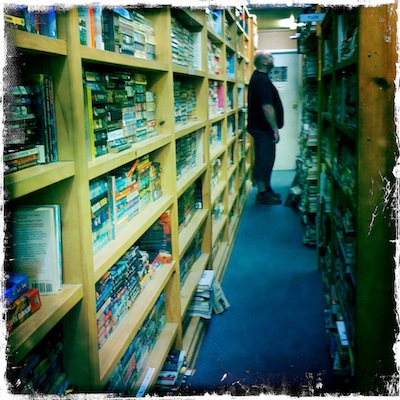
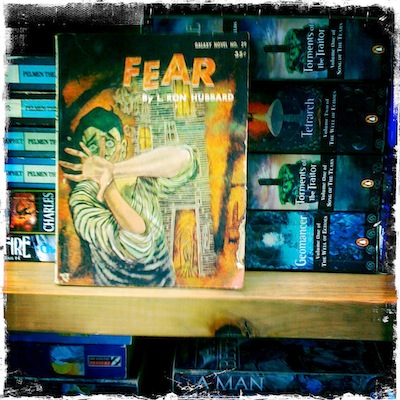
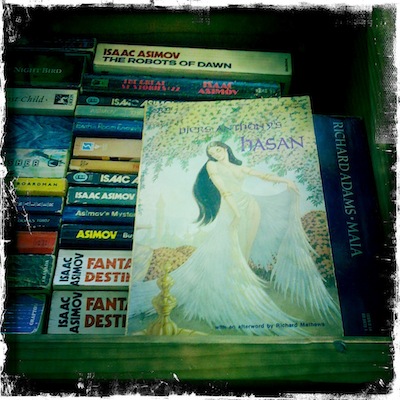
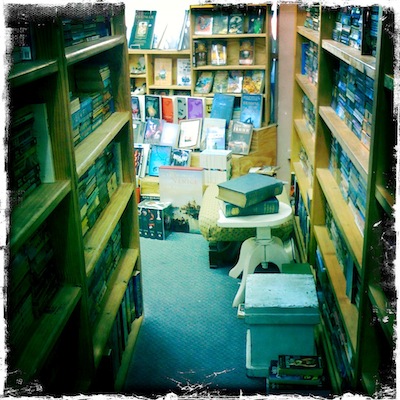
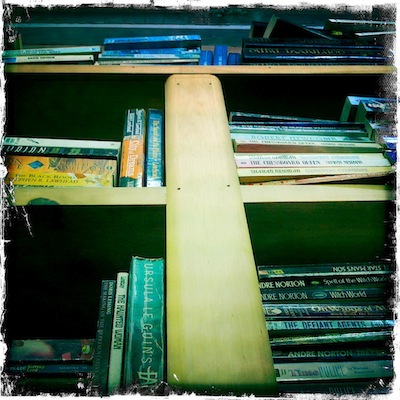
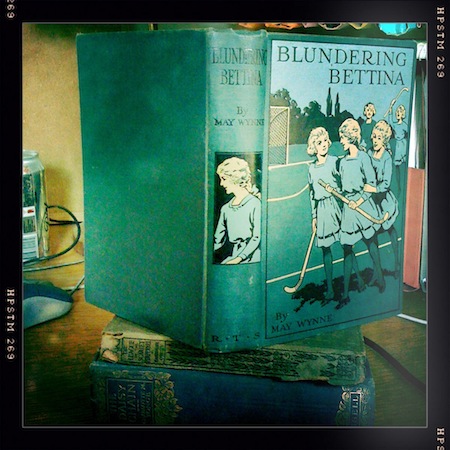
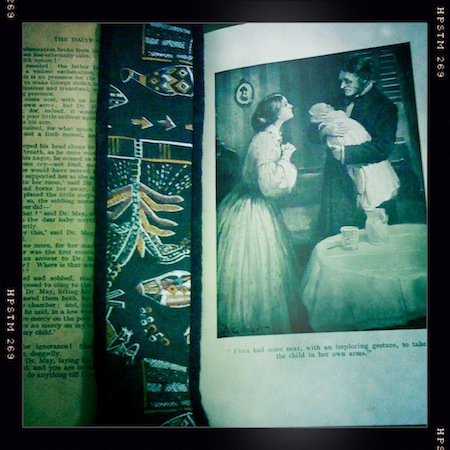
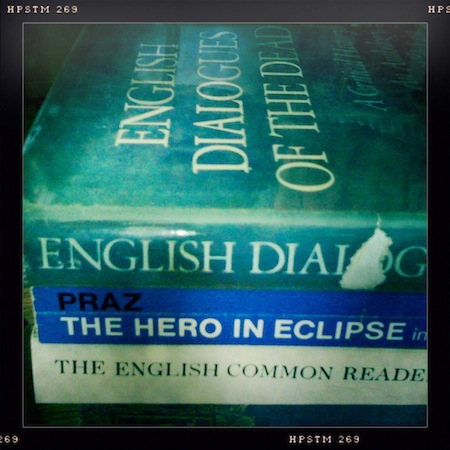
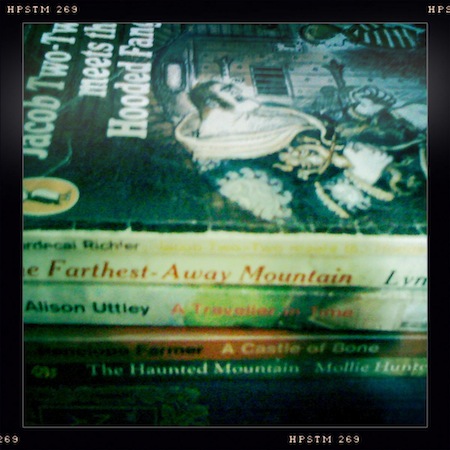
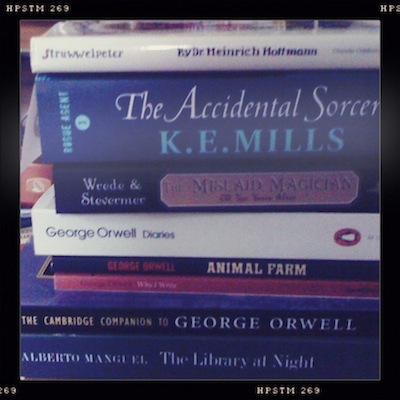
Books In Their Natural Environment, Part Three

Posted 12 February 2010 in

Let Me Tell You How Much I've Enjoyed The Gallagher Girls

Posted 1 February 2010 in

I know you’re dying to hear all about it.

Because you know me, right? (And if not, if you’re new to the blog, hi!) You know there’s nothing I love more than a good girls’ school story. Remember how excited I was when I discovered there was such a thing as vampire boarding-school stories?

This is like that time, only with spies.

The Gallagher Academy for Exceptional Young Ladies is ensconced behind high stone walls, bears all the hallmarks of a posh private (or public, depending on where you’re reading this) school, even attracts the scorn of the town’s residents, who have perfected what the girls call the “Gallagher Glare” whenever they spot a student in the town.

But it’s a school for spies.

And it’s more than that: it’s a school for the daughters of American spies (and one girl whose parents are MI6, brought in at the discretion of the new headmistress). Some of the girls, the ones whose parents aren’t spies, have been brought in because of exceptionally high test scores, so, as far as their parents are concerned, they really do just attend a school for exceptionally bright students. But they’re training all the while for a future career in either the CIA or some other initialism-heavy organisation.

When I first thought about writing a piece on these books, I was thinking to myself, “It would be so easy to write one of those snippet reviews you find in the back of women’s mags. You’d just write, ‘Harry Potter meets Alias‘ and you’d be done.”

To some extent, that reading still feels accurate to me. These books are like Alias: the insane gadgets, the almost superhuman powers of the spies, the frenetic excitement of the job. And they are like Harry Potter, and not just because they’re set in a boarding school: there’s a point in the series when the focal character Cammie Morgan goes to CIA headquarters with her mother for a debriefing, and accesses the building through a hidden elevator in a department-store changing room. There are shades there, to me, of the way Harry Potter’s world existed alongside, beneath, above, or around our own, but never quite overlapped.

That delights me.

I don’t want spies to be sitting in rooms peering at computer monitors. I want them to be rappelling down the sides of buildings and if, like Michelle Yeoh, they can do it in high heels, so much the better.

Even the titles of the books delight me: I’d Tell You I Love You, But Then I’d Have To Kill You; Cross My Heart and Hope To Spy; and Don’t Judge A Girl By Her Cover. (Apparently, the fourth one will be Only the Good Spy Young.)

Oh, don’t look at me like that: you know I love a bad pun from the time I wrote that blog post on Wuthering High (and its sequels, The Scarlet Letterman and Moby Clique).

But I’m not actually here to talk about puns. I want to mention instead the complex and fascinating way that these books negotiate interpersonal relationships.

The books are, according to Amazon.com’s method of categorisation, aimed at nine- to twelve-year-old readers, and that feels about right: there’s no sex, of course (unlike the Vampire Academy books, which are designed for older readers) and precious little kissing. They’re also distinctly heternormative: there’s no indication that any of the girls are attracted to other girls.

That’s not unusual for mainstream books in the 9-12 age range, of course.

But it’s also a stance that’s somewhat problematised by the books’ genre. Girls’ school stories don’t seem to be able to just adopt an unproblematic heternormative stance. Stories from the original burgeoning of the genre (from around the 1920s to roughly the 1950s) are frequently subjected to a kind of nudge-nudge wink-wink re-reading that draws on any hint of suggestiveness in the stories—I’ve done this myself, of course.

Sometimes the stories themselves are suggestive, as in the case of one I read that was a long moral tale arguing against passionate friendships with someone of your own gender: I wish I could remember the title of that one.

Perhaps that explains why more modern variants on the girls’ school stories foreground the heterosexuality of the pupils? In the Trebizon stories, for example, the girls are all paired off with their equivalent in the boys’ boarding school down the road, and the teachers encourage them to socialise together.

That would never happen at Malory Towers.

What happens in the Gallagher Girls series, though, is that these girls, who have been ensconced in a girls’ boarding school for the final seven years of their schooling, have absolutely no idea how to relate to the opposite sex.

None at all.

How would they? The only members of the opposite sex they’ve met since they were twelve—really, around the time you really start noticing other people as sexually or proto-sexually attractive—have been their teachers.

Most of them don’t even have a parental relationship as a model, because their parents are, by and large, spies out in the field. They don’t head home to home-cooked meals, family conversation, trips out to the zoo or shopping expeditions—they spend Christmas helping their parents trail arms dealers on the other side of the world.

Take the heroine Cammie, for example. She doesn’t even know how her parents met: it’s classified. So when she does meet a boy, she has no idea how to get to know him, except to treat it as a mission: she constructs an elaborate legend, presenting herself as a home-schooled, highly religious girl with a cat called Suzie, and she sneaks out of the school every chance she gets to meet this new boy.

It’s more complicated for Cammie, of course, because she’s what’s known as a “pavement artist”: her job is to trail suspects invisibly, or as near to invisibly as she can manage. And she’s good, too, but once she becomes aware of boys, she becomes rather more ambivalent: when a cute boy tells her he’d never have noticed her, she knows it’s a compliment, and part of her takes it that way, but part of her is hurt, too.

Cammie’s determination to pursue a boy who can’t know the truth about her school terrifies the teachers, who go so far, in a later book, as to arrange an exchange programme so the students can interact regularly with boys their own age.

Sure, much of what I like in these books comes down to the pavement-artist heroine, attractive but untrustworthy hero, the spy gadgets, the rappelling, and the occasional Code Red that locks the school down when out-of-the-loop parents drop by unannounced.

But I like, too, the way in which the books recognise that interpersonal relationships are complicated even if you do have a camera in your wrist watch and comms in your fake crucifix.

Re-reading Part One: Being Annoyed By David Eddings

Posted 25 January 2010 in

I’ll be completely honest here: I have no particular hatred for David Eddings.

I first read Eddings in my early teens. I’d read many, many fantasy stories as a child, all the (cliche alert!) old classics: Alan Garner, Susan Cooper, Lloyd Alexander, Lewis Carroll, C. S. Lewis, Diana Wynne Jones, and so on.

But I’d slipped away from fantasy for a while, and I came back to it through David Eddings—to Nick, I call him “gateway fantasy,” though I know other readers who’ve done the same through Robert Jordan (whom I’ve never read) or Raymond Feist (whom I’ve never finished).

I read Eddings (specifically, The Belgariad) when I was staying with my best friend at her father’s house up on the Northern Beaches. She’d been reading them over a previous visit, so she lay on one bed with book three and I lay on the other with book one, and we worked our way through the series like that, reading the funny bits out to each other.

And they did seem funny, at the time.

But the problem, for me, is that they don’t bear re-reading. I’m a big re-reader—hence this new series for the blog.

And Eddings doesn’t have any re-read value for me: when I re-read them over this Christmas break (out of desperation, since no one bought me any books for Christmas. Not one!), they just irritated me.

In fact, it was only sheer stubbornness that got me through The Mallorean, in the end.

So, do you want to know what really bothered me? And do you want it in list form? Of course you do.

1. Casual sexism

This is the big one, for me. Yes, there are powerful female characters in Eddings’s books, but their roles are severely restricted: they’re queens, sorceresses, witches, mystics, and priestesses. Not warriors. Rarely scholars. (And Eddings’s seeming contempt for academia is another big issue for me.)

They’re infrequently rulers in their own right and, when they are, they’re often ineffectual or powerless rulers like the drug-addled Salmissra.

There are some politicians, but they tend to manipulate their domains in much the way as they manipulate men. Because the sexism doesn’t just work one way in these books: women get their way by fluttering their eyelashes, and men are helpless to resist them.

It’s a wonder that anything ever gets done, really.

Somewhere in the depths of Polgara the Sorceress—though I can’t locate the actual page reference at this moment—Polgara mentions that she enjoys politics, but not in the sense of how kingdoms operate internally or externally. No, she likes politics according to the definition of politics that means (thought I’m paraphrasing here) “manipulating people into doing what I want them to do.”

But, then, if women understood politics, the male characters of The West Wing wouldn’t have anyone to info-dump on, would they?

I’m not even going to discuss the time that Belgarath says he’s jealous of his daughter’s suitors because all fathers are jealous—that’s just too Freudian and, frankly, creepy for me.

I wonder, too, why it’s necessary to protect the child-like Queen Ce’Nedra from any mention of anything to do with sex, when she’d been married for years and has a child. Yes, I agree you might not want your wife going into that brothel, Garion, but when it gets to the point where you can’t even mention in front of her that two secondary characters are lovers? Well, no wonder it took you so long to conceive an heir to the Rivan throne: it must be much harder when you can’t tell your wife what you’re doing.

But, you know, it’s not the sexism that bothers me so much as it’s the casual assumption of authority for the most dismissive and sexist of claims. So many sentences include some variation of the phrase “All women are” or “All men do” that you’re tempted to assume that, impossible though it is, the authors have never actually met anyone of the opposite gender.

I would write more on this, but when I got to the passage in Belgarath the Sorcerer where he apologised for calling his daughter extremely intelligent and then told her it was nothing to be ashamed of, my head exploded.

2. Casual racism

Actually, there’s nothing casual about the racism in these books, not when the plots are almost entirely driven by superficial but apparently extremely important racial differences. And while I’ve been drawing most of my examples from The Belgariad et al., this casual racism carries over into the later Elenium and Tamuli series, as well.

Add to that the general muddiness of definition between “race” and “culture,” and the whole angle of racism in the books becomes more confused. What we would often describe as cultural characteristics—such as the Arends’ overwhelming nobility—seem to be categorised as racial characteristics, which I find bewildering and just a little lazy. I’m also confused by how racial (or even cultural) traits work here: is it really possible for every single Arend to be as thick as two short planks? Every single one?

Still, the important point is this: for the life of me, I can’t figure out why it’s so important to the books that the bad guys are swarthy foreigners with almond-shaped eyes.

3. Casual cruelty

There are two key examples of this in the first hundred-odd pages of Belgarath the Sorcerer alone.

My first example is this: at one point just after Beldin—the deformed disciple of the god Aldur—arrives in the Vale for instruction, he’s telling Belgarath about how he was left exposed to die shortly after his birth, though his mother fed him until just after he learned to walk, when she either died or was killed by her people for sneaking out to sustain him. Thereafter, he learned to feed himself by following carrion birds and eating what they ate.

At which point Belgarath calls him an animal.

Well, possibly, Belgarath. Or possibly he’s a toddler who is trying to eat whatever he can find. Did you consider that possibility?

The second example is when Belgarath eviscerates an Eldrakyn (I’ve never been quite sure what those are, but something like an orc and something like a troll: intelligent creatures with the power of speech and the ability to domesticate other animals) and then laughs as the creature tries to hold its intestines inside its abdominal cavity.

But he feels “a little ashamed” when the creature starts crying, so that’s all right, then.

4. Idiot plotting

Here’s my favourite example: after the dragon-god Torak cracks the world in half during the War of the Gods, he is safe on the far side of the Sea of the East with Aldur’s Orb, his theft of which is the cause of the war. The people of the west spend two thousand years trying to cross the ocean before Cherek Bear-Shoulders and his sons find the land bridge.

But then they don’t cross the land bridge, because that’s the way Torak’s Angaraks will expect them to come. So they just walk across the frozen ocean instead.

I may have groaned out loud when I read that.

Was it a particularly cold winter? We’re not told that. But, then, the main characters do spend much of the books commenting on how stupid everyone else is. Perhaps that explains why crossing the ice never occurred to them in two thousand years.

Oh, but there are more examples. How about the fact that Chamdar the Grolim spends a thousand years searching for the heirs of Riva. He finally manages to get his hands on the newborn heir, burning the baby’s parents to death in the process. So this infant is the sole remaining heir of Riva—he will not have any brothers. He is the Godslayer whose rise Chamdar and his Grolims have spent a millennia trying to prevent.

But when Belgarath catches Chamdar at the burning house with the infant in his hands, Chamdar throws the baby at Belgarath so he can escape quickly.

No wonder it took him one thousand years to locate him in the first place.

On a sightly related note, I often wonder about the argument that since the books relate to two Prophecies (Eddings’s caps, not mine) divided by an accident in the distant past, the same events are going to keep recurring until one Prophecy is chosen over the other. Really, that’s just a retroactive explanation for why the plot of The Mallorean is largely identical to the plot of The Belgariad, isn’t it?

In fact, I know it is, because the characters keep pointing it out during The Mallorean.

5. Fondness for slavery

Do you know, I can’t even bring myself to discuss this, and yet it’s such a central part of his writing that I can’t delete the item, either. I’ll sum it up like this: even if slavery is codified within a society, it doesn’t necessarily follow that slaves are happy.

6. Confusing attitude towards racial purity

I think what confuses me most in Eddings’s attitude towards racial purity is that he places great emphasis on racial differences that are, at their heart, ambiguous. Take the Alorns, for example: four different peoples—Drasnians, Chereks, Rivans, and Algars—descended from Cherek Bear-Shoulders and his three sons.

The kingdom of Aloria was only divided into the four separate kingdoms three thousand years before the events of the main story, but that’s fair enough: even the descendants of full brothers can deviate widely after three millennia in vastly different climates. So we know the sneaky Drasnians differ from the silent Algars, the sober Rivans from the carousing Chereks.

But then at other times—many, many other times—characters will sigh “Alorns!” regardless of whether they’re speaking about Drasnians or Rivans, and the question of racial difference becomes muddied again.

Not too muddied, of course, because we have to remember that the bad guys are not of the same race as the good guys. That’s the important point.

And that’s not even considering how one keeps the line of the Rivan King essentially Rivan for one thousand years, when you’re marrying the various heirs off to Cherek, Algarian, or Sendarian girls constantly. Of course, with the exception of Sendars, those girls are all still Alorns, but the books don’t say they keep him Alorn; they say they keep him Rivan. The Rivan blood would become diluted after a short while, wouldn’t you think? Not that that’s a problem—unless you’re in a fantasy world obsessed with racial purity.

Of course, if I were to consider how the term “race” is apparently synonymous with “religion” in these books, we’d be here for the rest of the day.

Lifeline Bookfest 2010 (Part One)

Posted 18 January 2010 in

I know you’re all just dying to see what I bought at the Lifeline Bookfest. Aren’t you?

According to the omniscient Wikipedia, Howard Pyle was an American illustrator and writer of children’s stories, which explains how, despite my fascination with Victorian children’s fiction, I’ve never heard of him: I have read American nineteenth-century children’s fiction (Susan Coolidge and, of course, Louisa May Alcott), but not with the same assiduity that I read English nineteenth-century children’s fiction.

Or, at least, that’s my excuse, and I’m sticking to it.

Apparently (and by “apparently,” I mean “according to Wikipedia”), The Wonder Clock was published in 1887, and is based on European fairytales. That makes it right up my alley.

I’m also fascinated by the (it seems to me) particularly Victorian fascination with round-robin stories and long stories linked only by a single theme. Eliza Winstanley, for example, wrote one of the latter in the 1860s called “Voices from the Lumber Room,” in which various pieces of discarded furniture and accessories (a mirror, a chair, a fan) told stories about past members of the family.

Of course, “Voices from the Lumber Room” ended in a horrific holocaust, in which all the discarded but sentient furniture was chopped up for firewood, but they don’t all end so disastrously. Bow Bells used the idea of a round-robin story (in which various authors each wrote a chapter of a longer tale) or the loosely linked theme story (such as the one above) for their Valentine’s Day and Christmas Day special issues for years.

The Wonder Clock is along those lines: one story for each hour of the clock.

So let’s just say that this book, which I picked up entirely at random, hits a number of my fangirl buttons.

Now, the Jenny Nimmo book, Charlie Bone and the Time Twister, I’m partly really excited about, because it has the word “Academy” in the blurb, and that’s (excuse the cliche) a red rag to a bull for me. But I’m partly also rather annoyed, because it’s the second book. I couldn’t find the first book, and when I nipped into Angus and Robertson in desperation, I found it’s the second book of eight. So I’m in a for a serious commitment there, it seems.

The Garth Nix Keys to the Kingdom series I’m slowly picking up one book at a time, because I can’t face buying all seven at once. But I really enjoyed the Abhorsen trilogy, so I want to read them. I now have the first four, so I won’t have to put off reading them for much longer.

I also found a copy of Nix’s The Ragwitch at this sale, so there’s much Nix-reading in my future.

I bought the Carter Dickson book despite a vague sense that I already have either this exact book under another title or another book by Carter Dickson with a disturbingly similar plot. Eh, c’est la vie.

I’m also fairly sure it was a Carter Dickson novel—but not, alas, one that I own—on which I saw the greatest blurb I’ve ever seen in my life: “He took his whisky straight, his women curvy, and murder in his stride.”

Genius.

That skinny little book on the bottom? That’s a facsimile reprint of Shakespeare’s sonnets. Nothing but the text and a two-page essay on the reproduction and original conditions of publication. Just lovely.

Does anyone else have very fond memories of Dick King-Smith? The Sheep-Pig (now, sadly, generally published as Babe, as my own copy is) is still one of my favourite books, though I am well, well, well past the age when you’re supposed to read it. And, when we were children, we used to listen to books on tape on long car trips, and one of our favourites was The Fox Busters, about chickens who fight back.

(Hmm. It just occurred to me that enjoying both The Fox Busters and Fantastic Mr Fox should have made me one confused child, at least as far as foxes are concerned. Still, it doesn’t seem to have had any lasting effects.)

I haven’t read The Queen’s Nose in years, and I’m really looking forward to reading it again.

Buying The Catalogue of the Universe is part of my ambition to have a comprehensive Margaret Mahy collection, an ambition stemming from when a friend made me read The Changeover, about which I have written elsewhere.

Irritatingly, the one book I haven’t managed to find yet is The Changeover.

One book I am excited about in this pile is The Indian in the Cupboard, because, embarrassing admission though this is, I’ve never actually read it. Isn’t that shameful?

On a similar note, I’ve not read Bridge to Terebithia for years. I’m not even entirely sure that I want to read it again: it’s a lovely book, but a distressing one. But I saw it on the table, and suddenly thought I really wanted a copy of it on my shelves, just in case I did want to read it again. Or maybe just for the feeling of actually having it. I’m not sure which.

This last little pile is a bit of a mixed bag, isn’t it?

I’m not sure where the impulse to buy Betsy Byars came from. I used to read her books assiduously when I was about . . . what? Maybe eight? Or ten? (There’s a branch of Internet bragging that would have me strung up by my heels for admitting that, you know: I can’t count the number of times I’ve seen discussions of literacy devolve into an exchange of “Oh, well, I’d read the complete works of Shakespeare by the time I was twelve”/“Twelve? I’d read them by the time I was eight!” Well, I hadn’t: I was reading Betsy Byars.)

I haven’t read Byars in years, but these three were together, and I suddenly couldn’t resist them.

And at least this pile puts me that much closer to my ambition of a full series of Billabong and Laura Ingalls Wilder books.

No, I don’t know why I have that ambition. I just do.

Dante's Inferno: The Book of the Game of the Book

Posted 17 January 2010 in

You know, I don’t often use this blog as a response to things I’ve read on the Internet: it’s generally much more solipsistic than that.

But, do you remember, once upon a time, when I linked to the news about Dante’s Inferno becoming a video game?

And then I linked to the news about the rebranding of Wuthering Heights in line with Twilight?

Well, this post is something of a meeting of those two: meet the official tie-in version of Dante’s Inferno.

Bear in mind, though Kotaku are calling this the “novelisation” of the game, it’s not: it’s the original poem, in a nineteenth-century translation, in that cover.

Yes, that’s a half-naked man with a cross painted on his chest.

Yes, he’s holding a scythe made out of vertebrae.

Yes, it does say that it “includes an exclusive 16-page full-colour insert and a special introduction from [noted Dante scholar] the game’s executive producer.”

Yes, it is translated by Henry Wadsworth Longfellow, which means many people who buy this on the basis of the cover are going to be awfully disappointed when they open it up and find the poem inside.

Yes, it is tagged “the literary classic that inspired the epic video game from Electronic Arts.”

And, no: this is not a joke: here’s the Amazon page.

I shall leave the last word, as always, to Penny Arcade.

(But, just secretly? I almost think this would be worth having on my shelf just to boggle at occasionally. After all, I don’t have the Longfellow translation . . .)

Lessons I Have Learned From Reading Various Teen Romances

Posted 24 October 2009 in

1. If you don’t want to pressure your girlfriend to sleep with you, but you also know you’re (cliche alert!) “not willing to wait forever,” you probably shouldn’t be dating a fourteen-year-old girl when you’re in college.

Seriously.

Keep the May-December romances for when you’ve reached a commensurate degree of sexual and social maturity, okay? It’s just common sense.

2. If your immortal boyfriend says he’s loved you through all your various life cycles even though you’ve never managed to consummate your relationship, and he’s therefore willing to wait forever for you to be ready, you have about half a book before he

  • tries to take your pants off.
  • becomes really irritated with you and starts disappearing for long stretches of time
  • drinks your best friend’s blood
  • flirts with the school bully
  • wipes your memory
  • all of the above.

3. The important lesson to take from Madeleine L’Engle’s A Wrinkle in Time is that Meg Murry definitely had boobs. Because, after all, she already had glasses and braces, right? So no benevolent deity would also make her flat-chested, okay? That would just be mean.

4. If you say you’re a feminist, there’s nothing to stop you also fantasising about literally being your boyfriend’s property, including wanting to wear a bracelet engraved with “Property of [Boyfriend’s Name]” and justifying this by saying that it’s just like the fact that your cat’s collar has your name on it.

5. As a corollary to the above, the statement “I’m a feminist, right?” is so powerful that you only need to say it once every two or maybe three books to completely negate any unpleasant after-effects of statements such as the above.

6. That cute boy you just met? Chances are he’s either

  • your brother
  • immortally bound to his actual sister, so he has to marry her eventually. Even though she’s his sister.

7. If you’re fifteen and you haven’t started your menstrual cycle or, in fact, ever seen your own blood, even after injuries, you really should think about that. Sure, we don’t expect you to realise you’re a fairy, but you know you’re not a competitive gymnast. And you didn’t know anything was odd? Seriously?

8. Wherever there’s one cute boy, there’s always another one. It’s just a fact of life. Sure, one of them’s probably a vampire or a fairy or something, but you’ll just have to deal with that, because love triangles are inevitable.

Apparently.

9. Interspecies dating is no more complicated for teenage girls than it would be for a tiger who happened to meet a rather attractive lion. Trust me on this. Just don’t wonder whether your children will be sterile, because that’s not something that’s usually covered by the literature.

10. Boys like girls who have some kind of quirk. So if you’re not a fairy, or able to see fairies, or a vampire, or the spitting image of a vampire’s long-lost love, or, at a pinch, a Catholic schoolgirl, you’re just going to have to get a tattoo.

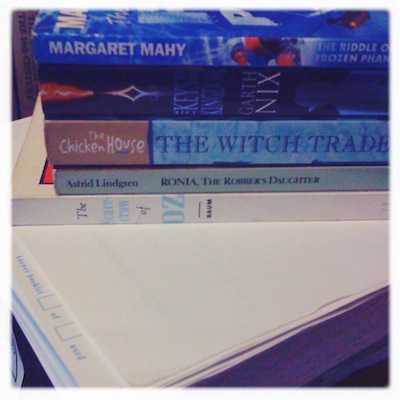
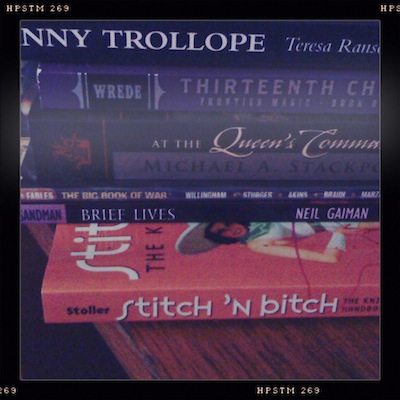
Books In Their Natural Environment, Part Two

Posted 20 October 2009 in

The Books of the Circulating Library

Posted 4 October 2009 in

I’ve mentioned before my struggles with Delicious Library 2, and my belief that, while it’s a wonderful invention, adding my back catalogue to it might actually kill me.

(Okay, I may not have phrased it quite that way, but I was thinking it.)

So this brings me to the new link I’ve added to my blogroll over there to your right: a slightly inaccurate link, since it’s not a blog, at all. It’s my library, which I’ve uploaded to space on the Internet.

Partly, I’m looking for a way to catalogue my books offline (though, having cleverly downloaded the app. before Amazon removed the rights to their catalogue for mobile apps, for reasons best known only to themselves, I do also have a copy of the catalogue on my iPhone).

Partly, though, it’s because this is, after all, the Circulating Library. I talk about my books here. I even fetishise my books here (and, honestly, everywhere else).

And linking to this catalogue means you can take a wander along my shelves, if you so wish.

The application does set the books out on shelves, so it feels as much like browsing a library as you can get on the Internet.

The application generates a primary shelf, which includes (in alphabetical order by author) every book you enter, and then allows you to create sub-shelves by author, genre, or any other category that helps you make sense of the chaos. When you’re dealing with a large number of books, the sub-shelves help keep the system saner than it often is in real life: they contain everything that’s on the primary shelf, but in small, easily digestible packets.

I chose only to publish my sub-shelves. I store some items on multiple shelves, so, for example, vampire boarding-school stories turn up under “Children’s Fantasy and Science Fiction” and “Girls’ School Stories,” just so I can always be sure of finding them. And some categories are under-represented, so far—like “Art”—because I haven’t made my way around to the bookcase on which they’re stored yet.

These 1800 books are not a complete record of all the books I own: it’s a library catalogue in progress.

Feel free to browse.

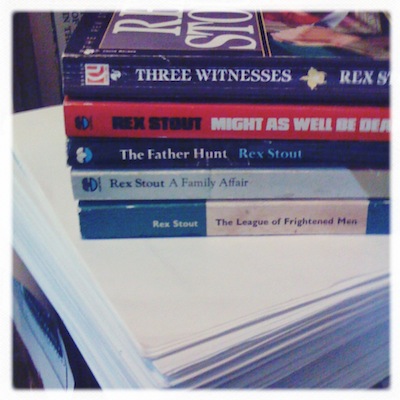
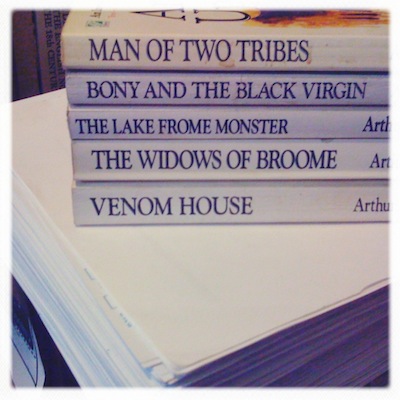
Books In Their Natural Environment

Posted 3 October 2009 in

Penny Dreadfuls

Posted 16 September 2009 in

Yesterday, I found in the letterbox the most recent catalogue of penny dreadfuls from Jarndyce, the antiquarian booksellers who specialise in eighteenth- and, especially, nineteenth-century books.

I bought a copy of Bow Bells Novelettes from Jarndyce some years ago, which is why they offered me a copy of this catalogue.

Seductive as it is, I doubt I’ll be able to buy anything from this catalogue (not even—sigh—the copy of Eliza Winstanley’s “Entrances and Exits” that they’re offering), but I do so love Jarndyce catalogues.

Look how beautiful this one is:

And it’s full of enticing illustrations from the penny dreadfuls themselves. Agnes Repplier, an American writer, wrote (in the late nineteenth century) an essay on English railway fiction (available here from Google books) in which she argued that “the seductive titles and cuts which form the tour de force of penny fiction bear but a feeble affinity to the tales themselves, which are like vials of skimmed milk, labelled absinthe, but warranted to be wholly without flavour” (211).

I don’t know about the absence of flavour, but I know the illustrations are fabulous.

Look at this cover for “The Boy Detective; or, The Crimes of London”:

From this, it appears as though most of the crimes are committed by the boy detective himself. Still, at least he provided himself with an appreciative audience.

And, on another note, how can he even see that a crime is being committed in that room, from the angle he’s standing on?

Or what about “Risen from the Dead”?

The actual caption for this one is “‘Great Heaven! Where am I?” exclaimed the supposed dead man,” but I prefer to imagine that the caption reads, “This is a pretty complicated way of getting out of telling your wife about us.”

Then again, I have too much time on my hands.

This one doesn’t have a caption, but I’m sure we can write our own.

My current choice is “Had she been capable of experiencing any emotions at all, Sivestra would have congratulated herself on having the foresight to bring her embroidery scissors to the planned seduction.”

Duchess Novelette is quite a late addition to the realm of Victorian periodicals: it ran from 1894 to 1902. (Indeed, the novelettes were generally quite late: there’s a fascinating 2008 article from Kate Macdonald and Marysa DeMoor on the production of novelettes and supplements from Publishing History, which you can find here. That’s a PDF file, but it should open in your browser.)

Its lateness in the period explains the relative sophistication of the cover image:

Nothing, however, can explain the fact that rather than “A Wild Love,” it should probably be titled “That’s Definitely Going to Give You a Crick in the Neck, You Know.”

Also, considering the heroine—at least, I’m assuming that’s the heroine—is dead here, the hero’s expression should probably verge more on “horrified” than on “slightly bewildered.”

Speaking of sophisticated images, this one is obviously from an earlier publication. It’s labelled “The Death Struggle”:

I would have labelled it “Slightly After the Main Struggle But a Disturbingly Long Time Before the Actual Deaths.”

This one’s my favourite, so far:

This caption reads, “Kairon stooped down and imprinted a kiss on the half-parted lips of the statue, and, as he did so, distinctly felt them move!”

Um, Kairon? Unless you thought there were a reasonable chance that the statue would come to life, why were you snogging it in the first place? And who makes a statue with “half-parted lips”? I’m thinking Pygmalion has been convinced to go into mass production.

And trust me: there’s a rational explanation for this last one.

Well, semi-rational.

Spring-heeled Jack was a specifically Victorian urban legend, and popular subject for the penny-dreadful market. Sadly, he hasn’t proved as durable as Sweeney Todd or Jack the Ripper, but he certainly had his own degree of fame.

I’m assuming that what appear to be whiskers are the blue-and-white flames he was said to vomit.

And I’m rather annoyed that, having already prepared a joke about why he might be wearing a unitard, I find, apparently, a tight-fitting oilskin is all part of the mythos.

He might have had more consideration for the needy bloggers of the future.

Well, I Wouldn't Say Literature Is Dead, Exactly . . .

Posted 6 September 2009 in

But, yes, I am as disturbed as the next person by the news I found over on Topless Robot: that HarperCollins is bringing out a new edition of Wuthering Heights—with a cover based around the cover art for Stephenie Meyer’s Twilight series, and a tag claiming that this is “Bella and Edward’s favourite book.”

That’s fine: you weep a little if you want. Or faint. Or giggle.

I’ll be here when you get back.

No, this is not a mock-up: here, have a look at the HarperCollins website, where you can pre-order this for only U.S.$8.99.

Now, I do have a problem with this and, oddly, it’s not the same as Topless Robot’s problem: I’m actually deeply fond of Wuthering Heights, as a good little nineteenth-century scholar should be.

It’s such a nasty book, you just have to enjoy it.

(Thought I do admit to bewilderment that people find Heathcliff sexy. Mr Rochester? Oh, my: yes. But Heathcliff? Not working for me, I have to say.)

And, as I’ve admitted here, I enjoyed the Twilight series—at least until Edward started really creeping me out in book three (why, yes: I am a little slow), and until I read book four.

But I have to ask: in what way is this Edward and Bella’s favourite book? If I recall correctly, Bella says it’s one of her favourites, but Edward says he can’t abide it, until he’s stuck with nothing to read while Bella talks in her sleep all night, and then he finds one of Heathcliff’s more psychotic passages about wanting to rend Edgar Linton limb from limb, and suddenly warms to the book.

Not what I would call the most common reason for enjoying Emily Bronte’s only novel.

In the long run, is this actually going to kill literature? I wouldn’t have thought so.

Is it going to make more people read Wuthering Heights? Well, it might make more people buy the novel, and I don’t suppose that the publisher cares whether the purchasers actually read it: it’s not as though Emily’s going to be writing a sequel any time soon.

So this doesn’t mark the death of literature, for me.

But it is deeply, deeply silly.

Still, there’s always amusement value in the tagline, which you can see better in the full-size image.

“Love Never Dies”?

That depends on your definition of “die,” doesn’t it?

And also of “love.”

The Great Spare-Room Book-Moving Debacle

Posted 6 September 2009 in

If you were following my Magical Mystery Bookshelf Tour last year, you’ll recall that the spare room was the point where I just stopped apologising for the appalling conditions in which I force my books to live.

In fact, it took me five separate posts before I finished that stage of the tour.

So it’s not really surprising that I decided the spare room needed an overhaul and a new bookshelf.

But despite careful measuring, the bookshelf I bought was slightly too big for the only available space, wasn’t it?

Of course it was.

So the overhaul turned out to be more extensive than planned. Every single item of furniture was moved in this room, and every single book taken off the shelves.

Still, the room looks much better.

In fact, if you were to stand in the direct centre of my spare room—well, you’d be standing on a patchwork quilt that my sister made me by hand, and I’d probably ask you not to do that.

Still, setting that aside for the time being, if you were to stand in the direct centre of my spare room and look from left to right, you’d see it looks like this now:

And, yes: that is an almost empty shelf there. Clearly, there are more than enough books still on the other shelves to fill that one up. But it gives me such a luxurious feeling of space, to have one shelf in the house that isn’t stuffed to capacity.

So empty it stays.

Until the next Lifeline Bookfest, anyway.
House of Night

Posted 29 August 2009 in

So (through which I “obliterate all previous discourse and narrative” and simultaneously call for immediate attention—thank you, Seamus Heaney) . . .

I may have mentioned once, or twice, or, perhaps, even three times, my current fascination with vampire boarding-school stories.

What I haven’t talked about in any detail, though, is P. C. and Kristin Cast’s House of Night series, only five books of which have so far been published.

Now, I’ll be honest: I didn’t take to these from the start.

Partly, it was that I was uncertain about a joint-written work, and suspected that the daughter part of the mother-and-daughter team had been largely brought in to make sure the language was idiomatically and authentically teenage.

Partly, it was that the authentically teenage language made me feel, in the early chapters, as though I were too old to be reading these books, which is (firstly) probably true, (secondly) an uncomfortable reading position, and (thirdly) irrelevant.

And partly it had nothing to do with the books at all, and everything to with circumstances. I’d taken the first volume down to Sydney with me along with the first volume of Cassandra Clare’s Mortal Intruments trilogy, not being certain whether I’d like either. Then I thoroughly enjoyed the Clare, and when it ended on a cliffhanger, I become so annoyed that I hadn’t thought to bring the second volume that I rather resented the book I did have.

When I gave the series another chance a month or so later, I was surprised by how much I did enjoy it.

You know, it’s almost impossible to write about vampire fiction, without talking about the modifications that authors make to the archetype. That, it seems, is the nature of vampire fiction: one selects a vampire protagonist, and then one tweaks the archetype a little (so that, to pull an example off the top of my head, your vampires sparkle in direct sunlight), and that’s all anyone talks about.

But it’s particularly impossible not to talk about that with this case, and I’ll explain why.
All vampire boarding-school stories that I have read have some justification for why there’s an all-vamp school. (This is one disadvantage that they have over the traditional boarding-school stories, since it seems that secret vampire societies don’t have any policies in place about universal education.)
So in Richelle Mead’s Vampire Academy series (and none of what is a spoiler: it’s all on the back of the first volume), there are two distinct forms of vampires, the “mortal” Moroi and the “immortal” Strigoi [yes, I have ret-conned this bit of the post: see Tim’s comments below], as well as the half-vampire, half-human dhampirs who act as guardians for the Moroi. Since the Moroi are in constant danger from the stronger, immoral, and immortal Strigoi, Moroi society is basically a succession of gated communities, of which the school is only one.

In Claudia Gray’s Evernight series, the school exists so that those vampires who were turned young and have lived long lives can find a safe place to learn about changes in modern society—so a vampire turned in the Middle Ages and living in isolation for most of the years since might find themselves programming an iPod as their end-of-year assessment task.

In the House of Night series, it all comes down to the changes to the archetype of the vampire.

In this world, vampyrism is a biological change that takes place in some people during adolescence. The new fledgling is “marked”: the tattooed outline of a crescent moon appears on their foreheads. At that point, they have two choices: they can die, or they can go to one of the world’s many Houses of Nights, where the adult vampyres secrete an airborne pheromone that helps keep the fledglings’ bodies stable.

Over the next four years, roughly ten percent of the fledglings die anyway, as their body rejects the Change. If they Change successfully, the crescent moon tattoo is filled in and another tattoo—unique to each vampyre, circling the eyes and covering the cheekbones—appears on their face at the moment of the Change.

So vampyres in this world aren’t secret: they can’t be, with sapphire-blue tattoos covering their faces. And, as an adolescent is marked, they become an emancipated minor under the law, free to choose their own names and subject only to the High Priestess of the House of Night and to their professors.

Interesting, huh?

And note that term “High Priestess.” These vampyres are both spiritual and matriarchal. They worship the goddess Nyx, the personification of the night, and, while the worship does involve blood, it also involves candles, herbs, circles of power, and such like.

And this is where my interest is really piqued. Because the heroine of these books is Cherokee, through her mother. And the vampyre rituals (and the threats to vampyre society that emerge across the books) become tied up with Cherokee legend and ritual.

(I’m far from informed on Native American legends, but it seems to me that these books modify aspects of Cherokee mythology to further their own plotlines—not that, as the cliche goes, there’s anything wrong with that. I can’t be certain, but it looks as though this Wikipedia page on the central villain of later books is drawn exclusively from the fiction, though presenting itself as an actual Cherokee legend: I’m assuming that, if that’s the case, it’s poor writing or confusion, and not deliberate obfuscation. On the other hand, authoritative sources show that this fictional threat is rooted in actual Cherokee legend.)

But, for me, it’s the mere focus on the Cherokee heroine that fascinates me, the fact that the heroine strengthens her rituals for Nyx by blending them with Cherokee purification rituals, that her knowledge of herbs (from her Cherokee grandmother) blends into this new religion that she never knew she needed.

When, later in the series, she is thrown into an accidental alliance with a Benedictine nun, and we see, running alongside the spiritual vampyres and the Cherokee wise woman, the matriarchal branch of the Catholic Church (and its elevation of the Virgin Mary to a position of importance with which other branches of Christianity are often uncomfortable), then they fascinate me further.

Does the teen-centric prose still frustrate me at times? Oh, yes.

But I’ve not read teen fiction quite like this before, and never a vampire boarding-school story like this. If only I didn’t have to wait until October for the next installment, alas!

Older Articles

Categories

Blogroll

Recent Comments

Monthly Archive

2010
January
February
March
2009
January
February
March
April
May
June
July
August
September
October
November
December
2008
February
March
April
May
June
July
August
September
October
November
December